نص قورش

نص قورش

النقش على قيد الحياة على قورش يتكون من 45 أسطر من النص مكتوب بالخط المسماري الأكادية ، وهي أول خطوط 35 منها على جزء "ألف" ، والباقي منها على جزء "ب". وهناك عدد من خطوط في بداية ونهاية النص هي تضررت بشدة لأكثر من بضع كلمات لتكون مقروءة.

كتب النص بأسلوب صيغ للغاية التي يمكن تقسيمها الى ستة أجزاء منفصلة :

    * خطوط 1-19 : مقدمة سب نابونيدوس ، ملك بابل السابقة ، وسايروس ربط مع مردوخ إله ؛
    * خطوط 20-22 : تفاصيل العناوين سايروس المالكة والأنساب ، ودخوله السلمية الى بابل ؛
    * 22-34 أسطر : الثناء للسياسة سايروس لاستعادة بابل ؛
    * خطوط 34-35 : صلاة لمردوخ باسم سايروس وابنه قمبيز ؛
    * خطوط 36-37 : إعلان عن حالة جيدة من الامبراطورية الفارسية ؛
    * خطوط 38-45 : تفاصيل عن أنشطة بناء أمر به سايروس في بابل.
مكسورة جزئيا بداية النص والمضمون على قيد الحياة تبدأ هجوما على شخصية الملك البابلي نابونيدوس المخلوع. وهو يسرد جرائمه المزعومة ، متهما إياه مع تدنيس المعابد للآلهة ، وفرض السخرة على السكان. وبسبب هذه الجرائم ، يعلن الكاتب ، ومردوخ إله بابل قد تخلى عن السعي إلى مزيد من ملك مناسبا. ودعا مردوخ سايروس عليها للدخول بابل وأصبح الحاكم الجديد بمباركة من الله :

    عبادة مردوخ ، ملك الآلهة ، وقال انه [نابونيدوس] [تشانغ] إد إلى المكروه. يوميا لكنه كان له فعل الشر ضد المدينة [بابل]... كان [مردوخ] الممسوحة ضوئيا وبدا [من خلال] جميع البلدان ، والبحث عن الحاكم الصالح مستعدة لقيادة [له] [في] موكب السنوية. [] ثم نطق اسم قورش ملك انشان ، أعلن له أن يكون [يأتي] حاكم كل العالم.

في منتصف الطريق من خلال النص ، والكاتب بالتبديل إلى أول شخص السرد ، وكأن سايروس والتصدي للقارئ مباشرة. وترد قائمة من ألقابه (في بلاد ما بين النهرين وليس على غرار الفارسية) : "أنا سايروس ، ملك العالم ، الملك العظيم ، الملك الشرعي ، ملك بابل ، ملك سومر وأكاد ، ملك أربعة جنوط [من و] الأرض ، ابن قمبيز ، الملك العظيم ، ملك انشان ، سليل Teispes ، الملك العظيم ، ملك انشان ، من الأسرة [التي] دائما [تمارس الملوكية] ؛ الذي حكم بيل [Markuk] نبو والحب ، والذين كانوا نريد ملكا لارضاء قلوبهم ". وهو يصف أفعال تقي الذي كان يقوم به بعد غزوه : فهو استعادة السلام الى بابل وغيرها من المدن المقدسة لمردوخ ، وتحرير سكانها من هم "نير" ، وقال انه "جلبت الإغاثة إلى مساكنهم المتهالكة (وبالتالي) وضع حد لهذه (الرئيسي) في الشكاوى ". إصلاح والمعابد المهدمة في المدن التي غزاها ، واستعادة كل الطوائف ، وعاد صورهم المقدسة فضلا عن سكانها السابقة التي اتخذت Narbonidus الى بابل. قرب نهاية سايروس نقش يبرز له من ترميم سور المدينة بابل ، قائلا : "في [المدخل] رأيت المدرج اسم الملك آشور بانيبال سلفي". ما تبقى هو في عداد المفقودين ولكن يفترض أن يصف تجديد الولاء لسايروس للعبارة المذكورة.

الطبيعة المجزأة للنقش يعني أن النص الكامل للاسطوانة كان ، لفترة طويلة ، غير واضحة وغير مكتملة. وكان محل النسخ الجزئي Weissbach فتحي حسن في عام 1911 من قبل النسخ أكثر من ذلك بكثير كاملة بعد التعرف على جزء "ب" ، وهذا متاح الآن باللغة الألمانية والانكليزية. طبعات عدة وترجم النص الكامل للاسطوانة على شبكة الإنترنت.

ترجمة وهمية من النص -- تؤكد ، من بين أمور أخرى ، تمت ترقية إلغاء الرق ، والحق في تقرير المصير ، وهو الحد الأدنى للأجور واللجوء -- على شبكة الإنترنت. لم خدعت الخبراء لأنه يشير إلى اهورا مازدا الألوهية الزرادشتية بدلا من بلاد ما بين النهرين الإله مردوخ. وقد تم تعميم الترجمة وهمية على نطاق واسع ؛ في اشارة الى مطالبتها بأن سايروس قال يفترض انه "يتعين على كل بلد أن يقرر لنفسه ما إذا كان يريد قيادة بلادي" ، الايرانية الفائزة بجائزة نوبل للسلام شيرين عبادي في خطاب القبول لها وصف سايروس باسم "الامبراطور جدا الذي أعلن في قمة السلطة 2500 سنة قبل ذلك... وقال انه لا حكم على الشعب اذا لم ترغب في ذلك ". من تأليف وترجمة وهمية غير معروفة ولكن الهولندي مؤرخ جونا Lendering واقترح أن أنشئت من أجلها لدعم الادعاء مشكوك فيها تاريخيا أن اسطوانة يمثل "الإعلان الأولى في العالم لحقوق الإنسان".

text of  Cyrus Cylinder

text of  Cyrus Cylinder

The surviving inscription on the Cyrus Cylinder consists of 45 lines of text written in Akkadian cuneiform script, the first 35 lines of which are on fragment "A" and the remainder of which are on fragment "B". A number of lines at the start and end of the text are too badly damaged for more than a few words to be legible.

The text is written in an extremely formulaic style that can be divided into six distinct parts:

    * Lines 1–19: an introduction reviling Nabonidus, the previous king of Babylon, and associating Cyrus with the god Marduk;
    * Lines 20–22: detailing Cyrus's royal titles and genealogy, and his peaceful entry to Babylon;
    * Lines 22–34: a commendation of Cyrus's policy of restoring Babylon;
    * Lines 34–35: a prayer to Marduk on behalf of Cyrus and his son Cambyses;
    * Lines 36–37: a declaration about the good condition of the Persian Empire;
    * Lines 38–45: details of the building activities ordered by Cyrus in Babylon.
The start of the text is partly broken; the surviving content begins with an attack on the character of the deposed Babylonian king Nabonidus. It lists his alleged crimes, charging him with desecration of the temples of the gods and the imposition of forced labor  upon the populace. Because of these offences, the writer declares, the god Marduk has abandoned Babylon to seek a more fit king. Marduk called forth Cyrus to enter Babylon and become its new ruler with the god's blessing:

    The worship of Marduk, the king of the gods, he [Nabonidus] [chang]ed into abomination. Daily he used to do evil against his city [Babylon] ... He [Marduk] scanned and looked [through] all the countries, searching for a righteous ruler willing to lead [him] [in the annual procession]. [Then] he pronounced the name of Cyrus, king of Anshan, declared him to be[come] the ruler of all the world.

Midway through the text, the writer switches to a first-person narrative, as if Cyrus were addressing the reader directly. A list of his titles is given (in a Mesopotamian rather than Persian style): "I am Cyrus, king of the world, great king, legitimate king, king of Babylon, king of Sumer and Akkad, king of the four rims [of the earth], son of Cambyses, great king, king of Anshan, descendent of Teispes, great king, king of Anshan, of a family [which] always [exercised] kingship; whose rule Bel [Markuk] and Nebo love, whom they want as king to please their hearts." He describes the pious deeds he performed after his conquest: he restored peace to Babylon and the other cities sacred to Marduk, freeing their inhabitants from their "yoke", and he "brought relief to their dilapidated housing (thus) putting an end to their (main) complaints". He repaired the ruined temples in the cities he conquered, restored their cults, and returned their sacred images as well as their former inhabitants which Narbonidus had taken to Babylon. Near the end of the inscription Cyrus highlights his restoration of Babylon's city wall, saying: "In [the gateway] I saw inscribed the name of my predecessor King Ashurbanipal". The remainder is missing but presumably describes Cyrus's rededication of the gateway mentioned.

The fragmentary nature of the inscription meant that the full text of the Cylinder was, for a long time, unclear and incomplete. A partial transcription by F.H. Weissbach in 1911 was supplanted by a much more complete transcription after the identification of the "B" fragment; this is now available in German and in English. Several editions of the full translated text of the Cylinder are available online.

A fake translation of the text – affirming, among other things, the abolition of slavery and the right to self-determination, a minimum wage and asylum – has been promoted on the Internet. It has not deceived experts because it refers to the Zoroastrian divinity Ahura Mazda rather than the Mesopotamian god Marduk. The fake translation has been widely circulated; alluding to its claim that Cyrus supposedly said "Every country shall decide for itself whether or not it wants my leadership", Iranian Nobel Peace Prize winner Shirin Ebadi in her acceptance speech described Cyrus as "the very emperor who proclaimed at the pinnacle of power 2,500 years ago that ... he would not reign over the people if they did not wish it". The authorship of the fake translation is unknown but the Dutch historian Jona Lendering has suggested that it was created to buttress the historically dubious claim that the Cylinder represents "the world's first declaration of human rights".

Cyrus Cylinder

منشور حقوق بشر کوروش

منشور حقوق بشر کوروش
منشور حقوق بشر کوروش یا استوانه کوروش دوم (بزرگ) لوحی از گل پخته است که در سال ۵۳۸ پیش از میلاد به فرمان کوروش دوم هخامنشی  پادشاه و بنیانگذار شاهنشاهی هخامنشی نگاشته شده است. نیمه نخست این لوح از زبان رویدادنگاران بابلی و نیمه پایانی آن سخنان و دستورهای کورش به زبان و خط میخی اکدی (بابلی نو) نوشته شده‌است. این استوانه در سال ۱۲۵۸ خورشیدی/ ۱۸۷۹ میلادی در نیایشگاه اِسَگیله (معبد مردوک، خدای بزرگ بابلی) در شهر بابل باستانی پیدا شده‌ و در موزه بریتانیا در شهر لندن نگهداری می‌شود.[۱] این منشور یکی از بزرگترین نشانه‌های روحیهٔ بردباری در فرهنگ ایرانی است. [۲]
تاریخچه
اکتشاف

در سال ۱۲۵۸ خورشیدی/ ۱۸۷۹ میلادی به هنگام کاوشهای باستان‌شناسی هیئت بریتانیایی در محوطه باستانی بابل در بین‌النهرین (میان‌رودان)، هرمزد رسام، باستان‌شناس بریتانیایی آسوری‌تبار، استوانهٔ گلی‌ای را یافت که شامل نوشته‌هایی به خط میخی بود.[۳] جنس این استوانه از گل رس است، ۲۲.۵ سانتی‌متر طول و ۱۱ سانتی‌متر عرض دارد و دور تا دور آن ۴۵ سطر (به جز بخش‌های تخریب‌شده) به خط و زبان اکدی (بابلی نو) نوشته شده‌است. بررسی‌های بعدی نشان داد که نوشته‌های استوانه در سال ۵۳۸ پیش از میلاد به فرمان کوروش بزرگ پس از شکست دادن نبونید و تصرف کشور بابل، نویسانده شده است. این اثر در نیایشگاه اِسَگیله (معبد مردوک) در شهر بابل قرار داده شده‌ بود. در حال حاضر این لوح سفالین استوانه‌ای در بخش «ایران باستان» در موزه بریتانیا نگهداری می‌شود.

از سوی دیگر، در سال ۱۳۷۵ آشکار شد که بخشی از یک لوحه استوانه‌ای که آن را متعلق به نبونید پادشاه بابل می‌دانستند، در حقیقت پاره‌ای از استوانه کوروش بزرگ، از سطرهای ۳۶ تا ۴۳ است. پس از این آگاهی، این پاره از لوح استوانه‌ای که در دانشگاه ییل (Yale) در آمریکا نگهداری می‌شد، به موزه بریتانیا در لندن انتقال داده شد و به استوانه اصلی پیوست گردید.
ساخت منشور

کوروش دوم یا کورش کبیر، بنیان‌گذار پادشاهی ایران و آغازگر سلسله هخامنشیان، پس از تسخیر بابل، در بابل بر تخت پادشاهی نشست کرد و ادیان بومی را آزاد اعلام کرد. برای جلب محبت مردم میانرودان (بین‌النهرین)، مردوک که بزرگترین خدای بابل بود را به رسمیت شناخته، او را نیایش کرد و سپاس گفت. او هیچ گروه انسانی را به بردگی نگرفت و سپاهیانش را از تجاوز به مال و جان رعایا بازداشت. او تمامی کسانی را که به اسارت به بابل آورده شده بودند گرد هم آورد و منزلگاه آنها را به ایشان بازگرداند. کوروش همچنین قوم یهود را نیز از اسارت و بیگاری در بابل آزاد کرد.

به دستور کوروش، شرح وقایع و دستورات وی روی یک لوح استوانه‌ای سفالین نگاشته شد و در معبد مردوک قرار گرفت.
جایگاه
طرفداران

از طرف برخی این سند به عنوان نخستین منشور حقوق بشر شناخته می‌شود[۴][۵][۶] و در سال ۱۹۷۱ میلادی، سازمان ملل آن را به شش زبان رسمی سازمان منتشر کرد. بدلی از این منشور در مقر سازمان ملل متحد در شهر نیویورک نگهداری می‌شود[۷].
مخالفان

اطلاق عنوان «نخستین منشور حقوق بشر» توسط برخی دیگر مورد اعتراض قرار گرفته است و نامگذاری این استوانه را به این نام به حکومت پهلوی نسبت می دهند.

کلاوس گالاس (Klaus Gallas) متخصص تاریخ هنر که در شهر وایمار سرگرم تدارک فستیوال فرهنگی آلمان و ایران بود که متوجه ناهمخوانی‌هایی در این منشور شد. او می‌گوید: "سازمان ملل یک خطای بزرگ مرتکب شده است."[۸]

پرفسور امیلی کورت از محققان تاریخ خاورمیانه به وجود دروغ‌های بزرگی در این منشور که کوروش برای توجیه فتح بابل بکار برده ، اشاره می‌کند.[۹]

بروس لینکلن به چهار قیام مردم بابل بر علیه حکومت پارس‌ها اشاره کرده و ماهیت این منشور را زیر سؤال می برد.[۱۰]
محتوای منشور در تورات

در باره فرمان کوروش مبنی بر آزادی یهودیان، اشاره‌هایی در باب‌های گوناگون عزرا و اشعیا در کتاب تورات (عهد عتیق) در دست است: "خداوند روح کوروش پادشاه فارس را برانگیخت تا در تمامی ممالک خود فرمانی صادر کند و بنویسد کوروش پادشاه فارس چنین می‌فرماید که یهوه خدای آسمان مرا چنین امر فرموده است که خانه‌ای برای او که در اورشلیم که در یهودا است، بنا نمایم. پس همگی برخاسته و روان شدند تا خانه خداوند را بنا نمایند. و کوروش پادشاه، ظروف خانه خداوند را که نبوکدنصر (بخت‌النصر) آنها را از اورشلیم آورده و در خانه خود گذاشته بود، بیرون آورد و به رئیس یهودیان سپرد".

برگردان

نسخه‌های جعلی بسیاری از ترجمه این منشور موجود است.[۱۱] در این لوح استوانه‌ای، کوروش پس از معرفی خود و دودمانش و شرح مختصر فتح بابل، می‌گوید که تمام دستاوردهایش را با کمک و رضایت مردوک خدای بابلی به انجام رسانده است. وی سپس بیان می‌کند که چگونه آرامش و صلح را برای مردم بابل و سومر و دیگر کشورها به ارمغان آورده، و پیکر خدایانی که نبونید از نیایشگاه‌های مختلف برداشته و در بابل گردآوری کرده بوده را به نیایشگاه‌های اصلی آنها برگردانده‌است. پس از آن، کوروش بزرگ می‌گوید که چگونه نیایشگاه‌های ویران‌شده را از نو ساخته و مردمی را که اسیر پادشاه‌های بابل بودند به میهن‌شان برگردانده‌است. در این نوشته اشارهٔ مستقیمی به آزادی قوم یهود  از اسارت بابلیان نشده، اما با مطالعه و پژوهش منابع تاریخی مشخص شده‌است که آزادی یهودیان بخشی از سیاست کوروش پس از فتح بابل بوده است.[۱۲][۱۳][۱۴][۱۵]

برگردان و ترجمه متن کامل این منشور چنین است:

    * خط ۱. «کورش» (در متن بابلی : «کو - رَ - آش»)، شاه جهان، شاه بزرگ، شاه توانمند، شاه «بـابـِل»(با - بی - لیم)، شاه «سـومـر»(شو- مـِ - ری) و «اَکـَّد»(اَ‌ک - کـ َ- دی - ای)، ...
    * خط ۲. ... همهٔ جهان.

از این جا تا پایان سطر نوزدهم، نه از زبان کورش، بلکه به روایت ناظری ناشناخته که می‌تواند نظر اهالی و بزرگان بابل باشد، بازگو می‌شود.

    * خط ۳. ... مرد ناشایستی به فرمانروایی کشورش رسیده بود.
    * خط ۴. او آیین‌های کهن را از میان برد و چیزهای ساختگی به جای آن گذاشت.
    * خط ۵. معبدی بَدلی از نیایشگاه «اِسَـگیلَـه»(اِ- سَگ - ایلَـه) برای شهر «اور»(او - ریم) و دیگر شهرها ساخت.

«اِسَـگیـلَـه / اِزاگیلا» نام نیایشگاه بزرگ «مردوک» یا خدای بزرگ است. این نام شباهت فراوانی با نام نیایشگاه ایرانی «اِزَگین» در «اَرَتـَه» دارد که در حماسهٔ سومری «اِنمِـرکار و فرمانروای اَرَته» بازگو شده‌است. آقای «جهانشاه درخشانی» در «آریاییان، مردم کاشی و دیگر ایرانیان»(تهران، ۱۳۸۲، ص ۵۰۷)، «اِزَگین» را به معنای «سنگ لاجورد» می‌داند. از سوی دیگر «کاسیان» نیز رنگ آبی را رنگ خداوند به شمار می‌آوردند و «کاشـّو / کاسـّو»، نام خدای بزرگ آنان به معنای «رنگ آبی» است. امروزه همچنان واژهٔ «کاس» برای رنگ آبی در گویش‌های محلی بکار می‌رود. برای نمونه در گیلان، مردان با چشم آبی را «کاس آقا» خطاب می‌کنند. همچنین برای آگاهی از پیوند اَرَتـَه با نواحی باستانی ِحاشیهٔ هلیل رود در جنوب جیرفت بنگرید به : مجیدزاده، یوسف، جیرفت کهن‌ترین تمدن شرق، تهران، ۱۳۸۲

    * خط ۶. او کار ناشایست قربانی کردن را رواج داد که پیش از آن نبود ... هر روز کارهایی ناپسند می‌کرد، خشونت و بدکرداری.
    * خط ۷. او کارهای ... روزمره را دشوار ساخت. او با مقررات نامناسب در زنـدگی مـردم دخالت می‌کرد. اندوه و غم را در شهرها پراکند. او از پرستش «مَـردوک»(اَمَـر - اوتو) خدای بزرگ روی برگرداند.

گمان می‌رود نام «مردوک» با واژهٔ آریایی و اوستایی «اَمِـرِتات/ مرداد» به معنای «جاودانگی / بی مرگی» در پیوند باشد. اما ویژگی‌های دیگر مردوک شباهت‌هایی با «اهورامزدا» دارد و همچون او در سیارهٔ «مشتری» متجلی می‌شده‌است. همان گونه که مردوک را با نام «اَمَـر - اوتو» می‌شناخته اند؛ از او با نام آریایی و کاسی ِ«شوگورو» نیز یاد می‌کرده‌اند که به معنای «بزرگ‌ترین سرور» بوده و با معنای اهورامزدا (سرور دانا / سرور خردمند) در پیوند است.

    * خط ۸. او مردم را به سختی معاش دچار کرد. هر روز به شیوه‌ای ساکنان شهر را آزار می‌داد. او با کارهای خشن ِخود مردم را نابود می‌کرد ... همهٔ مردم را.
    * خط ۹. از ناله و دادخواهی مردم، «اِنلیل / ایـلـّیل» خدای بزرگ (= مردوک) ناراحت شد ... دیگر ایزدان آن سرزمین را ترک کرده بودند.

منظور آبادانی و فراوانی و آرامش.

    * خط ۱۰. مردم از خدای بزرگ می‌خواستند تا به وضع همهٔ باشندگان روی زمین که زندگی و کاشانهٔ شان رو به ویرانی می‌رفت، توجه کند. مردوک خدای بزرگ اراده کرد تا ایزدان به «بابـِل» بازگردند.
    * خط ۱۱. ساکنان سرزمین «سومِـر» و «اَکـَّد» مانند مردگان شده بودند. مردوک به سوی آنان متوجه شد و بر آنان رحمت آورد.
    * خط ۱۲. مردوک به دنبال فرمانروایی دادگر در سراسر همهٔ کشورها به جستجو پرداخت. به جستجوی شاهی خوب که او را یاری دهد. آنگاه او نام «کورش» پادشاه «اَنـْشان»(اَن - شـَ - اَن) را برخواند. از او به نام پادشاه جهان یاد کرد.
    * خط ۱۳. او تمام سرزمین «گوتی»(کو - تی - ای) را به فرمانبرداری کورش درآورد. همچنین همهٔ مردمان «ماد»(اوم - مـان مَـن - دَه) را. کـورش با هر «سیاه سر» (منظور همهٔ انـسان‌ها) دادگرانه رفتار کرد.

در تداول، نام ِبابلی «اومان‌منده» را با «ماد» برابر می‌دانند. اما به نظر می‌آید که این نام بر همه یا یکی از اقوام آریایی که در هزارهٔ دوم پیش از میلاد به میان دورود مهاجرت کرده بوده اند؛ اطلاق می‌شده‌است.

    * خط ۱۴. کورش با راستی و عدالت کشور را اداره می‌کرد. مردوک، خدای بزرگ، با شادی از کردار نیک و اندیشهٔ نیکِ این پشتیبان ِمردم خرسند بود.
    * خط ۱۵. او کورش را برانگیخت تا راه بابل را در پیش گیرد؛ در حالی که خودش همچون یاوری راستین دوشادوش او گام برمی داشت.

ممکن است منظور دیده شدن سیارهٔ مشتری بوده باشد. در باورهای ایرانی، سیارهٔ مشتری نماد آسمانی ِ«اهورامزدا / مردوک» بوده‌است. نک به : بارتل ل. واندروردن، پیدایش دانش نجوم، ترجمهٔ همایون صنعتی زاده، ۱۳۷۲. او حتی منظور از «سپاه پر شمار او» را نیز ستارگان آسمان می‌داند.

    * خط ۱۶. لشکر پر شمار او که همچون آب رودخانه‌ای شمارش ناپذیر بود، آراسته به انواع جنگ افزارها در کنار او ره می‌سپردند.
    * خط ۱۷. مردوک مقدر کرد تا کورش بدون جنگ و خونریزی به شهر بابل وارد شود. او بابل را از هر بلایی ایمن داشت. او «نـَبـونـید»(نـَ - بو - نـ َ- اید) شاه را به دست کورش سپرد.
    * خط ۱۸. مردم بابل، سراسر سرزمین سومر و اَکـَّد و همهٔ فرمانروایان محلی فرمان کورش را پذیرفتند. از پادشاهی او شادمان شدند و با چهره‌های درخشان او را بوسیدند.
    * خط ۱۹. مردم سروری را شادباش گفتند که به یاری او از چنگال مرگ و غم رهایی یافتند و به زندگی بازگشتند. همهٔ ایزدان او را ستودند و نامش را گرامی داشتند.
    * خط ۲۰. منم «کورش»، شاه جهان، شاه بزرگ، شاه توانمند، شاه بابـِل، شاه سومر و اَکـَّد، شاه چهار گوشهٔ جهان.

از این جا روایت به صیغهٔ اول شخص و از زبان کورش بازگو می‌شود. استرابو نقل می‌کند که «کورش» نامی است که او پس از پادشاهی و با الهام از رود «کـُر» در جنوب پاسارگاد بر خود نهاد. پیش از این ، نام او «اَگـرَداتوس»(Agradatus) (اَگـرَداد / اَگـراداد) بوده‌است. نک به : جغرافیای استرابو، ترجمهٔ هـ. صنعتی زاده، ۱۳۸۲، ص. ۳۱۹.

    * خط ۲۱. پسر «کمبوجیه»(کـ َ- اَم - بو - زی - یَه)، شاه بزرگ، شاه «اَنـْشان»، نـوهٔ «کـورش»(کـورش یکم)، شاه بزرگ، شاه اَنشان، نبیرهٔ «چیش پیش» (شی - ایش - بی - ایش)، شاه بزرگ، شاه اَنشان.
    * خط ۲۲. از دودمانی کـه همیشه شاه بوده‌اند و فرمانروایی اش را «بـِل / بعل» (بـ ِ- لو) (خداوند / = مردوک) و «نـَبـو»(نـ َ- بو) گرامی می‌دارند و با خرسندی قلبی پادشاهی او را خواهانند. آنگاه که بدون جنگ و پیکار وارد بابل شدم؛

«نـَبو» ایزد نویسندگی و دبیری بوده، و نیایشگاه او به نام «اِزیدَه» خوانده می‌شده‌است. ورود کورش «بدون جنگ و پیکار» به بابل، نه تنها در گزارش او، بلکه در متون بابلی همچون «سالنامهٔ نبونید» و نیز در «تواریخ هرودوت»(کتاب یکم) تایید شده‌است. برای آگاهی از سالنامهٔ نبونید نگاه کنید به : Hinnz, W., Darios und die Perser, I, ۱۹۷۶, p. ۱۰۶.

    * خط ۲۳. همهٔ مردم گام‌های مرا با شادمانی پذیرفتند. در بارگاه پادشاهان بابل بر تخت شهریاری نشستم. مَردوک دل‌های پاک مردم بابل را متوجه من کرد، زیرا من او را ارجمند و گرامی داشتم.

پذیرش کورش توسط مردم، در «کورش نامه / سیروپدی»(Curou Paideia) نوشتهٔ گزنفون نیز تأیید شده‌است. گزنفون اظهار می‌دارد که مردمان همهٔ کشورها با رضایت خودشان پادشاهی و اقتدار کورش را پذیرفته بودند (سیروپدی، کتاب یکم).

    * خط ۲۴. ارتش بزرگ من به صلح و آرامی وارد بابل شد. نگذاشتم رنج و آزاری به مردم این شهر و این سرزمین وارد آید.
    * خط ۲۵. وضع داخلی بابل و جایگاه‌های مقدسش قلب مرا تکان داد ... من برای صلح کوشیدم. نـَبونید، مردم درماندهٔ بابل را به بردگی کشیده بود، کاری که در خور شأن آنان نبود.
    * خط ۲۶. من برده داری را برانداختم. به بدبختی‌های آنان پایان بخشیدم. فرمان دادم که همهٔ مردم در پرستش خدای خود آزاد باشند و آنان را نیازارند. فرمان دادم که هیچ کس اهالی شهر را از هستی ساقط نکند. مردوک از کردار نیک من خشنود شد.
    * خط ۲۷. او بر من، کورش، که ستایشگر او هستم، بر پسر من «کمبوجیه» و همچنین بر همهٔ سپاهیان من،
    * خط ۲۸. برکت و مهربانی اش را ارزانی داشت. ما همگی شادمانه و در صلح و آشتی مقام بلندش را ستودیم. به فرمان مَردوک همهٔ شاهانی که بر اورنگ پادشاهی نشسته اند؛
    * خط ۲۹. و همهٔ پادشاهان سرزمین‌های جهان، از «دریای بالا» تا «دریای پایین»(دریای مدیترانه تا دریای فارس)، همهٔ مردم سرزمین‌های دوردست، همهٔ پادشاهان «آموری»(اَ - مور - ری - ای)، همهٔ چادرنشینان،
    * خط ۳۰. مـرا خراج گذاردند و در بابل بر من بوسه زدند. از ... تا «آشـور» (اَش - شور) و «شوش» (شو - شَن)
    * ۳۱. من شهرهای «آگادِه»(اَ - گـَ - دِه)، «اِشنونا»(اِش - نو - نَک)، «زَمبان»(زَ - اَم - بـَ - اَن)، «مِتورنو»(مـِ - تور - نو)، «دیر»(دِ - ایر)، سرزمین «گوتیان» و شهرهای کهن آن سوی «دجله»(ای - دیک - لَت) که ویران شده بود را از نو ساختم.
    * خط ۳۲. فرمان دادم تمام نیایشگاه‌هایی که بسته شده بود را بگشایند. همهٔ خدایان این نیایشگاه‌ها را به جاهای خود بازگرداندم. همهٔ مردمانی که پراکنده و آواره شده بودند را به جایگاه‌های خود برگرداندم. خانه‌های ویران آنان را آباد کردم. همهٔ مردم را به همبستگی فرا خواندم.

با این که هیچ دلیل قاطعی در زرتشتی بودن ِکورش بزرگ در دست نیست؛ اما او همچون زرتشت به این باور کهن ایرانی پایبند بوده‌است که هر کس در پرستش خدای خود و انتخاب دین خود آزاد است.

    * خط ۳۳. هم چنین پیکرهٔ خدایان سومر و اَکـَّد را که نـَبونید بدون واهمه از خدای بزرگ به بابل آورده بود؛ به خشنودی مَردوک به شادی و خرمی،
    * خط ۳۴. به نیایشگاه‌های خودشان بازگرداندم، بشود که دل‌ها شاد گردد. بشود، خدایانی که آنان را به جایگاه‌های مقدس نخستین شان بازگرداندم،

گشایش و بازسازی نیایشگاه‌ها به فرمان کورش، دست‌کم در یک متن دیگر شناخته شده‌است. بر این لوح چهار سطری که از «اَرَخ» در میان دورود کشف شده، آمده‌است : «منم کورش، پسر کمبوجیه، شاه توانمند، آن که «اِسَگیلَه» و «اِزیدَه» را باز ساخت.» برای آگاهی بیشتر نگاه کنید به صفحهٔ ۱۵۶ مقالهٔ W. Eilers در کتاب شناسی.

    * خط ۳۵. هر روز در پیشگاه خدای بزرگ برایم خواستار زندگانی بلند باشند. بشود که سخنان پر برکت و نیک خواهانه برایم بیابند. بشود که آنان به خدای من مَردوک بگویند: «به کورش شاه، پادشاهی که تو را گرامی می‌دارد و پسرش کمبوجیه جایگاهی در سرای سپند ارزانی دار.»

در باورهای ایرانی، «سرای سپند» یا «اَنَـغْـرَه رَئـُچَـنـْگـْه» (اَنـَغران / اَنارام) به معنای «روشنایی ِبی پایان و جایگاه خدای بزرگ یا اهورامزدا و بهشت برین است.

    * خط ۳۶. بی گمان در روزهای سازندگی، همگی ِمردم بابل، پادشاه را گرامی داشتند و من برای همهٔ مردم جامعه‌ای آرام فراهم ساختم. (صلح و آرامش را به تمامی مردم اعطا کردم) ...
    * خط ۳۷. … غاز، دو اردک، ده کبوتر. برای غازها، اردک‌ها و کبوتران …

از سطر ۳۷ تا ۴۵ بخش نویافته‌ای است که در مقالهٔ «دربارهٔ منشور کورش» به آن اشاره شد. این نُه سطر دنبالهٔ بلافصل سطرهای پیشین نیست.

    * خط ۳۸. ... باروی بزرگ شهر بابل بنام «ایمگور-اِنلیل»(ایم - گور - اِن - لیل) را استوار گردانیدم ...
    * خط ۳۹. ... دیوار آجری خندق شهر را،
    * خط ۴۰. ... که هیچ یک از شاهان پیشین با بردگان ِبه بیگاری گرفته شده به پایان نرسانیده بودند؛
    * خط ۴۱. ... به انجام رسانیدم.
    * خط ۴۲. دروازه‌هایی بزرگ برای آن‌ها گذاشتم با درهایی از چوب «سِدر» و روکشی از مفرغ ...
    * خط ۴۳. ... کتیبه‌ای از پادشاهی پیش از من بنام «آشور بانیپال»(آش - شور - با - نی - اَپ - لی)
    * خط ۴۴. ...
    * خط ۴۵. ... برای همیشه ![۱۶]

منشور کوروش در ایران

در جریان جشن‌های ۲۵۰۰ ساله شاهنشاهی ایران، منشور کوروش به رغم مخالفت دولت وقت بریتانیا برای چند روز به ایران آورده شد و به نمایش در آمد.[۱۷] برای بار دوم منشور حقوق بشر کوروش برای نمایش به مدت ۴ ماه در روز جمعه ۱۰ سپتامبر ۲۰۱۰ ساعت ۴:۲۵ دقیقه صبح تحت تدابیر امنیتی از بریتانیا وارد تهران شد. به همراه این منشور ویترین نمایش آن نیز آورده‌شد. مذاکرات برای انتقال این اثر تاریخی از ۵ سال پیش آغار شده‌بود که نهایتاً ۲ سال قبل موزه بریتانیا با انتقال آن به ایران موافقت کرد. [۱۸] [۱۹] [۲۰]

در روز شنبه ۲۱ شهریور ۱۳۸۹ مراسم رونمایی از منشور با حضور و سخنرانی محمود احمدی‌نژاد و اسفندیار رحیم مشایی برگزار شد. طی این مراسم احمدی نژاد چفیه‌ی خود را بر گردن ۲ نفر که به‌عنوان نماد یک سرباز هخامنشی و کاوه آهنگر در مراسم حضور داشتند و سپس یک جوان بسیجی انداخت.[۲۱] در این مراسم نیل مک گرگور رئیس موزه بریتانیا در سخنرانی خود که پیرامون تاریخچهٔ منشور کوروش بود، حکومت کوروش را «بزرگترین امپراطوری جهان» و فتح بابل و منشور کوروش را «پیروزی امپراطوری هخامنشی» و «فرازی از تاریخ یهودیان» توصیف کرد و این منشور را یک «میراث همگانی و متعلق به همه انسان‌ها» دانست.[۲۲]

منابع


    * تصویرها برگرفته ز: [The Circle of Ancient Persian Studies]

    * پیشگفتار و متن کامل منشور برگرفته از کتاب: منشور کوروش هخامنشی، رضا مرادی غیاث‌آبادی، چاپ هشتم، تهران، ۱۳۸8.

   1. ↑ برج آزادی پس از۲۰ سال شسته می‌شود (فارسی). وب‌گاه رسمی.
   2. ↑ رضاییان, فرزین. هفت رخ فرخ ایران. چاپ ابیانه، انتشارات دایره سبز، ۱۳۸۶، ۵۲.
   3. ↑ مذاکره بر سر نمایش منشور کوروش در ایران (بی‌بی‌سی فارسی)
   4. ↑ Preview Cyrus The Great - Spenta Productions makes films about history's untold stories Cyrus the Great Movie
   5. ↑ Human Rights Day, ۱۰ December ۲۰۰۷
   6. ↑ THE IRANIAN: United Nations, Kofi Anan, Iranians, Cyrus, Human Rights
   7. ↑ http://www.livius.org/a/1/inscriptions/cyrus.pdf
   8. ↑ Falling for Ancient Propaganda: UN Treasure Honors Persian Despot - SPIEGEL ONLINE - News - International
   9. ↑ Kutsko, John F. (2000). Between Heaven and Earth: Divine Presence and Absence in the Book of Ezekiel. Winona Lake, IN: Eisenbrauns. ISBN 1-57506-041-8.
  10. ↑ Lincoln, Bruce (2007). Religion, empire and torture: the case of Achaemenian Persia, with a postscript on Abu Ghraib. Chicago: University of Chicago Press. ISBN 978-0-226-48196-8.
  11. ↑ The Cyrus Cylinder
  12. ↑ The Cyrus Cylinder
  13. ↑ British Museum - Cyrus Cylinder
  14. ↑ History of Iran: Cyrus the Great: The decree of return for the Jews, 539 BCE
  15. ↑ پایگاه پژوهشی آریابوم - منشور کورش بزرگ
  16. ↑ منشور کوروش هخامنشی (فارسی). پژوهش‌های ایرانی.
  17. ↑ مذاکره بر سر نمایش منشور کوروش در ایران (بی‌بی‌سی فارسی)
  18. ↑ همشهری آنلاین
  19. ↑ جام‌جم آنلاین
  20. ↑ خبرگزاری فارس
  21. ↑ جمشید برزگر (در تاریخ ۲۱ شهریور ۱۳۸۹). هخامنشیان بسیجی و جنگ قدرت؛ از تمدن بزرگ تا تمدن نوین (فارسی). وب‌گاه بی‌بی‌سی فارسی. بازدید در تاریخ ۲۲ شهریور ۱۳۸۹.
  22. ↑ احمدي‌نژاد به کاوه آهنگر چفیه داد+عکس (فارسی). وب‌گاه تابناک (در تاریخ ۲۱ شهریور ۱۳۸۹). بازدید در تاریخ ۲۲ شهریور ۱۳۸۹.

فولکلور,فلكلور ,Folklore

فولکلور
فولکلور (به انگلیسی: Folklore) را می‌توان مجموعه‌ای شامل افسانه‌ها، داستان‌ها، موسیقی، رقص، تاریخ شفاهی، ضرب‌المثل‌ها، هزلیات، باورهای عامه، رسوم دانست.فولکلور از دو کلمه انگلیسی فولک به معنی توده و لور به معنی دانش تشکیل شده است[۱].

فولکلور را بیشتر در بررسی توده‌های عامی مردم می‌جوید معمولاً در میان اقوام قدیمی بحز قبایل وحشی نمونه‌هایی از فولکلور یافت می‌شود[۲].واژه فولکلور را برای اولین بار ویلیام تامس عتیقه‌شناس انگلیسی در مقاله‌ای که موضوع آن بحث دربارهٔ دانش عامیانه و آداب و رسوم سنتی بود بیان داشت[۳].این اصطلاح از نیم قرن پیش نیز در ایران و ادبیات آن راه یافته‌است و به‌تدریج این اصطلاح به‌معنی دانش عامیانه و دانستنی‌های تودهٔ مردم رواج یافت و «فرهنگ عامه»، «فرهنگ عامیانه»، «فرهنگ توده» و «فرهنگ مردم» نامیده شد[۴].
فولکلور در ایران
ایران به لحاظ قدمت تاریخی دارای تنوع آداب و رسوم و عقاید است و به همین لحاط دارای فولکلر غنی است.در ایران افسانه‌سرایی و قصه‌گویی از سنن دیرباز ایرانیان محسوب می‌شود.

شواهد افسانه‌ها و اساطیر ایران از زمان زرتشت و صدها سال قبل از او در اوستا منعکس است. سوای آثار مکتوب، هزاران قصه و افسانه و داستان بطور شفاهی و دهان به دهان در دهات و شهرها و کوهپایه‌های این مرز و بوم رایج بود که یا در قهوه خانه‌ها و یا شبها در خانه‌ها نقل می‌شد و شاید تا بیست سال بیش در هر خانواده لااقل یک نفر که بهتر قصه بگوید و ده‌ها داستان بداند وجود داشت و زندگی و آداب و رسوم ما رنگ غنی و خاص فولکلوریک خود را دارا بود[۵].
جُستارهای وابسته

    * فرهنگ عامه
 منابع
   1. ↑ فولکلور (فارسی). وب‌گاه دهخدا (در تاریخ ‏۲ شهریور ۱۳۸۷).
   2. ↑ هویت ملی در سایه فولکلور (فارسی). وب‌گاه باشگاه اندیشه (در تاریخ ‏۲ شهریور ۱۳۸۷). بازدید در تاریخ شهریور ۱۳۸۷.
   3. ↑ Georges, Robert A., Michael Owens Jones, «Folkloristics: An Introduction,» Indiana University Press, ۱۹۹۵.
   4. ↑ فولکلور (فارسی). وب‌گاه آفتاب (در تاریخ ‏۲ شهریور ۱۳۸۷). بازدید در تاریخ شهریور ۱۳۸۷.
   5. ↑ روح الامینی، محمود، مبانی انسان‌شناسی گرد شهر با چراغ صفحه ۲۶۶

فلكلور عربي
هي الموروثات الشعبية التي تنتشر في البلدان العربية و التي تشتمل على الرقص الشعبي و الرويات الشفوية و الأغاني الشعبية وهي أغاني تعبر عن عادات و تقاليد كل شعب من الشعوب العربية من أنواع الغناء الشعبي السناد وهو الغناء الثقيل ذو الترجيع الكثير النغمات و النبرات الذي يعتمد على القافية المطلقة و من أنواع الغناء الشعبي أيضا الهزج وهو الغناء الخفيف الذي يرقص عليه و يمشي بالدف و المزمار و هناك الزجل وهو اللعب و الجبلة و التطريب و رفع الصوت و سمي كذلك بسبب رفع الصوت فيه و ترجعيه في الإنشاد و هناك الموال و يقسم إلى موال شامي موال مصري و هو خماسي و موال بغدادي و هو سباعي.

الحكايات الشعبية و هي تصور أحداثا من الماضي أو تجمع بين الواقع و الخيال في رؤية فنية أو ما يردده الناس من حكايات و خرافات تتضمن ما تم توارثه من عادات و تقاليد من الزمن الماضي و في الفلكور العربي تم توارث سير الأبطال و ملاحم البطولة مثل سيرة سيف ذي يزن و عنترة بن شداد و أبو زيد الهلالي و غيرهم من أبطال التاريخ العربي و كذلك اللطائف و النوادر الساخرة التي تصور بعباراتها الموجزة مثل و من الشخصيات الطريفة التي تم توارثها من الماضي شخصية أشعب و شخصية الطنبوري و حذائه و شخصية جحا و غيرهاو يشمل الفلكور العربي أيضا الرسم و النقش و النحت و صناعة الدمى و تطريز الملابس و الحلي و فنون التزيين و غيرها من الفنون.

يعتبر الفلكلور العربي غني بمواد المأثورات الشعبية التي سجلها الرواد الأوائل من المفكرين العرب في مخطوطاتهم و مدوناتهم الفكرية و الأدبية مثل الجاحظ و الأصفهاني و ابن خلدون و غيرهم.

و من المأثورات التي وصلتنا كتاب ألف ليلة وليلة وهو ملحمة أدبية شرقية تتناول قصص ترويها شهرزاد للملك شهريار تمتد على مدى ألف ليلة و ليلة تنهي شهرزاد الليلة بجزء مشوق و مثير من القصة لتكملة في الليلة القادمة وهكذا ليجبر الملك لإبقائها على قيد الحياة حتى الليلة القادمة و تضمنت القصص شخصيات متوارثة من جيل إلى جيل مثل شخصية السندباد البحري و شخصية علي بابا و الأربعين لصا و شخصية معروف الإسكافي الذي ختم بها كتاب ألف ليلة و ليلة.

هناك كم غير يسير مما هو مدون من الفلكلور العربي مدون كان أصلا مادة شفهية إنتبه إلى أهميتها كثير من الرواد الأوائل من المفكرين العرب فسجلوها و أثبتوها بالتدوين و الدراسة.

كما يشمل الفلكور العربي أيضا اللهجات التي تم توارثها من جيل إلى جيل و هي تختلف من دولة عربية إلى دولة عربية أخرى و تختلف من منطقة إلى منطقة أخرى داخل كل دولة.


Folklore
Folklore consists of culture, including stories, music, dance, legends, oral history, proverbs, jokes, popular beliefs, customs and so forth within a particular population comprising the traditions (including oral traditions) of that culture, subculture, or group. It is also the set of practices through which those expressive genres are shared. The academic and usually ethnographic study of folklore is sometimes called folkloristics. The word 'folklore' was first used by the English antiquarian William Thoms in a letter published by the London Journal Athenaeum in 1846.[1] In usage, there is a continuum between folklore and mythology. Stith Thompson made a major attempt to index the motifs of both folklore and mythology, providing an outline into which new motifs can be placed, and scholars can keep track of all older motifs.

Folklore can be divided into four areas of study: artifact (such as voodoo dolls), describable and transmissible entity (oral tradition), culture, and behavior (rituals). These areas do not stand alone, however, as often a particular item or element may fit into more than one of these areas.[2]
 Artifacts
Elements such as dolls, decorative items used in religious rituals, hand-built houses and barns,[3] and handmade clothing and other crafts are considered to be folk artifacts, grouped within the field as "material culture." Additionally, figures that depict characters from folklore, such as statues of the three wise monkeys may be considered to be folklore artifacts, depending on how they are used within a culture.[4] The operative definition would depend on whether the artifacts are used and appreciated within the same community in which they are made, and whether they follow a community aesthetic.
Oral tradition

Folklore can contain religious or mythic elements, it equally concerns itself with the sometimes mundane traditions of everyday life. Folklore frequently ties the practical and the esoteric into one narrative package. It has often been conflated with mythology, and vice versa, because it has been assumed that any figurative story that does not pertain to the dominant beliefs of the time is not of the same status as those dominant beliefs.[citation needed] Thus, Roman religion is called "myth" by Christians. In that way, both "myth" and "folklore" have become catch-all terms for all figurative narratives which do not correspond with the dominant belief structure.

Sometimes "folklore" is religious in nature, like the tales of the Welsh Mabinogion or those found in Icelandic skaldic poetry. Many of the tales in the Golden Legend of Jacob de Voragine also embody folklore elements in a Christian context, as well as the tales of Old Mr. Brennan. Examples of such Christian mythology are the themes woven round Saint George or Saint Christopher. In this case, the term "folklore" is being used in a pejorative sense. That is, while the tales of Odin the Wanderer have a religious value to the Norse who composed the stories, because it does not fit into a Christian configuration it is not considered "religious" by Christians who may instead refer to it as "folklore."

"Folktales" is a general term for different varieties of traditional narrative. The telling of stories appears to be a cultural universal, common to basic and complex societies alike. Even the forms folktales take are certainly similar from culture to culture, and comparative studies of themes and narrative ways have been successful in showing these relationships. Also it is considered to be an oral tale to be told for everybody.
On the other hand, folklore can be used to accurately describe a figurative narrative, which has no sacred or religious content. In the Jungian view, which is but one method of analysis, it may instead pertain to unconscious psychological patterns, instincts or archetypes of the mind. This may or may not have components of the fantastic (such as magic, ethereal beings or the personification of inanimate objects). These folktales may or may not emerge from a religious tradition, but nevertheless speak to deep psychological issues. The familiar folktale, "Hansel and Gretel", is an example of this fine line. The manifest purpose of the tale may primarily be one of mundane instruction regarding forest safety or secondarily a cautionary tale about the dangers of famine to large families, but its latent meaning may evoke a strong emotional response due to the widely understood themes and motifs such as “The Terrible Mother”, “Death,” and “Atonement with the Father.”

There can be both a moral and psychological scope to the work, as well as entertainment value, depending upon the nature of the teller, the style of the telling, the ages of the audience members, and the overall context of the performance. Folklorists generally resist universal interpretations of narratives and, wherever possible, analyze oral versions of tellings in specific contexts, rather than print sources, which often show the work or bias of the writer or editor.

Contemporary narratives common in the Western world include the urban legend. There are many forms of folklore that are so common, however, that most people do not realize they are folklore, such as riddles, children's rhymes and ghost stories, rumors (including conspiracy theories), gossip, ethnic stereotypes, and holiday customs and life-cycle rituals. UFO abduction narratives can be seen, in some sense, to refigure the tales of pre-Christian Europe, or even such tales in the Bible as the Ascent of Elijah to heaven. Adrienne Mayor, in introducing a bibliography on the topic, noted that most modern folklorists are largely unaware of classical parallels and precedents, in materials that are only partly represented by the familiar designation Aesopica: "Ancient Greek and Roman literature contains rich troves of folklore and popular beliefs, many of which have counterparts in modern contemporary legends" (Such as Mayor, 2000).

Vladimir Propp's classic study Morphology of the Folktale (1928) became the basis of research into the structure of folklore texts. Propp discovered a uniform structure in Russian fairy tales. His book has been translated into English, Italian, Polish and other languages. The English translation was issued in USA in 1958, some 30 years after the publication of the original. It was met by approving reviews and significantly influenced later research on folklore and, more generally, structural semantics. Though his work was based on syntagmatic structure, it gave the scope to understand the structure of folktales, of which he discovered thirty one functions.[5]
Cultural

Folklorist William Bascom states that folklore has many cultural aspects, such as allowing for escape from societal consequences. In addition, folklore can also serve to validate a culture (romantic nationalism), as well as transmit a culture's morals and values. Folklore can also be the root of many cultural types of music. Country, blues, and bluegrass all originate from American folklore. Examples of artists which have used folkloric themes in their music would be: Bill Monroe, Flatt and Scruggs, Old Crow Medicine Show, Jim Croce, and many others. Folklore can also be used to assert social pressures, or relieve them, for example in the case of humor and carnival.

In addition, folklorists study medical, supernatural, religious, and political belief systems as an essential, often unspoken, part of expressive culture.
Rituals

Many rituals can sometimes be considered folklore, whether formalized in a cultural or religious system (e.g. weddings, baptisms, harvest festivals) or practiced within a family or secular context. For example, in certain parts of the United States (as well as other countries) one places a knife, or a pair of scissors, under the mattress to "cut the birth pains" after giving birth. Additionally, children's counting-out games can be defined as behavioral folklore.[6]
Categories of folklore
    * Genres
          o Archetypes, stereotypes and stock characters.
          o Ballad
          o Blason Populaire
          o Childlore
          o Children's street culture
          o Counting rhymes
          o Costumbrismo
          o Craft
          o Custom
          o Epic poetry
          o Factoids
          o Festival
          o Folk art
          o Folk belief
          o Folk magic
          o Folk medicine
          o Folk metaphor
          o Folk narrative
                + Anecdote
                + Fable
                + Fairy tale
                + Ghost story
                + Joke
                + Legend
                + Myth
                + Parable
                + Tall tale
                + Urban legend
          o Folk play
          o Folk poetry and rhyme
          o Folk simile
          o Folk song
          o Games
          o Holiday lore and customs
          o Mythology
          o Riddle
          o Saying
                + Maxim
                + Proverb
          o Superstition
          o Taunts
          o Weather lore
          o Xerox lore

National or ethnic
Further information: List of mythologies

    * American folklore
          o Canadian folklore
          o Latin American folklore
                + Brazilian folklore
                + Caribbean folklore
                + Colombian folklore
          o United States folklore
    * Australian folklore
    * East Asian
          o Chinese folklore
          o Japanese folklore
          o Korean folklore
    * European
          o Albanian folklore
          o Alpine (Austrian and Swiss) folklore
          o English folklore
          o Estonian folklore
          o Dutch folklore
          o Finnish folklore
          o French folklore
          o German folklore
          o Hungarian folklore
          o Irish folklore
          o Italian folklore
          o Lithuanian folklore
          o Maltese folklore
          o Montenegrin folklore
          o Romanian folklore
          o Scandinavian folklore
          o Scottish folklore
          o Slavic folklore
                + Polish folklore
                + Russian folklore
          o Spanish Folklore
          o Swiss folklore
          o Welsh folklore
    * Near Eastern
          o Aggadah
          o Arab folklore
          o Iranian folklore
          o Jewish folklore
          o Turkish folklore
    * South Asian
          o Indian folklore
          o Pakistani folklore
    * Southeast Asian
          o Philippine folklore

References

   1. ^ Georges, Robert A., Michael Owens Jones, "Folkloristics: An Introduction," Indiana University Press, 1995.
   2. ^ Georges, Robert A., Michael Owens Jones, "Folkloristics: An Introduction," pp.313 Indiana University Press, 1995.
   3. ^ Kniffen, Fred, and Henry Glassie. "Building in Wood in the Eastern United States: A Time-Place Perspective." In Thomas J. Schlereth, ed., Material Culture Studies in America. Nashville, Tenn.: AASLH Press, 1982.
   4. ^ Wolfgang Mieder, "The Proverbial Three Wise Monkeys," Midwestern Journal of Language and Folklore 7 (1981):5-38.
   5. ^ L. V. Propp, Morphology of the Folktale, Second Edition, revised and edited with a Preface of Louis A. Wagner, University of Texas Press, 1968.
   6. ^ Kenneth S. Goldstein, "Strategy in Counting Out: An Ethnographic Folklore Field Study," in Elliott M. Avedon and Brian Sutton-Smith, eds., The Study of Games New York: John Wiley & Sons, 1971.


معماری یونان باستان

مذهب

نام و شهرت خدایان یونانی مذهب یونانی ها یک پدیده طبیعی گسترش یافته بود.خدایان یونانی ها شخصیت یافته یک عنصر ویژه بودند یا به عنوان قهرمان شناخته شده بودند و هر شهر یا منطقه اولویت ها، مراسم و سنت های خود را داشت. هیچ مقام کشیشی در آن دوره رایج نبود و کشیش ها عضای یک طبقه انتصاری نبودند ولی زندگی معمولی اجتماع را هدایت می‌کردند. اسامی خدایان اصلی یونان و آنچه بدان مشهورند به شرح زیر است:

زئوس(zeus)- عالی ترین خدایان و فرمانروای آسمان ها

هرا(Hera)- همسر زئوس، خدای ازدواج

آپولو(Apollo)- خدای قانون و منطق ، هنر و موسیقی و شعر سرایی ، یابنده شهرها

آتنا(Athena)- خدای فرزانگی و آموزش

پوسیدون(Poseidon)-خدای دریا

دیونوسوس(Dionysus)-خدای شراب ، جشن و خوشگذرانی

دیمیتر(Demeter)-خدای زمین و کشاورزی

آرتمیس(Artemis)- خدای شکار

هرمس(Hermes)- پیام رسان خدایان

آفرودیت(Aphrodite)- خدای بازرگانی

هفاستوس(Hephaestus)- خدای آتش، شعله و خداوند جعلی صنایع دستی

آرس(Ares)- خدای جنگ

هادس(Hades)- خدای زیر زمین

خدای زئوس ، پوسیدون و هادس به عنوان «بزرگ‌ترین سه خدا» نیز شناخته می‌شدند زیرا از همه قدرتمندتر بودند. همچنین هراکلس یا هرکول Heracles) یا (Hercules خدای قدرت و زور بازو یا خدای جمع محسوب می‌شد.

معماری عمومی یونان
معبد رایجترین و بهترین نوع شناخته شده معماری عمومی یونان است و معبد عملکرد یکسانی مانند کلیسای مدرن نداشت. زیرا منبر زیذ آسمان باز در اراضی شهری یا در معبدی مقدس و قبل از معبد قرار می‌گرفت. معابد به عنوان ذخیره کنجینه‌های مربوط به آیین چند خدایی قرار می‌گرفت. معابد به عنوان ذخیره گنجینه‌های مربوط به آیین چند خدایی قرار می‌گرفت یا به عنوان مکان باستان بت ها بود ولی از زمان فیدیاس (Pheidias) به یک کار هنری بزرگ تبدیل شد. معبد جایی برای زاهدان خدا بود و در آنجا مجسمه‌ها ، کلاه خودها و اشلحه خو را به عنون صدقه رها می‌کردند. فضای داخل معبد یا سلا (cella) به عنوان جا خزینه قرار می‌گرفت و معمولاً یک ردیف دیگر از ستون داشت.

از دیگر فرم های به کار رفته توسط یونانی ها تولوس (Tholos) یا معبد دوار است که بهترین نمونه آن تولوس تئودوریوس(Teodorios) در شهر دلفی است که برای پرستش آتنا (خدای فرزانگی و آموزش) اختصاص داده شده است؛ پروپولیا (propylon) که به منزله ورودی جایگاه‌های مقدس است.( که بهترین نمونه آن پروپولیا آکروپولیس آتن است.)؛ خانه‌های فواره‌ای که در آن زنان کوزه‌های خ.د را از یک فواره عمومی پر می‌کردند؛ و استوا (stoa) که یک فضای بلند و کشیده و یک ردیف ستون در یک سمت استکه این ردیف به عنوان مغازه در مراکز تجاری شهر های یونانی بکار گرفته می‌شد. نمونه کامل یک استوا، استوای آتولوس در آتن وجود دارد. شهرهای یونانی با اندازه‌های قابل توجه یک ژیمناسیوم (gymnasium) یا پالاسترا ( palaestra)داشتند که یک مرکز اجتماعی برای شهروندان مرد بود. این فضاهای محصور شده به آسمان باز می‌شدند و فضایی برای مسابقات قهرمانی و ورزش بودند. شهرهای یونانی همچنین نیاز به یک بولتریون ( bouleterion) یا اتاق شورا بود؛ ساختمان بلند که به‌عنوان دادگاه ومکانی برای اجتماع شورای شورای شهر استفاده می‌شد، زیرا یونانی ها از تاق و گنبد استفاده نمی‌کردند زیرا نمی‌توانستند با این روش ساختمان هایی با فصضاها و دهنه‌های باز بسازندو بولترین ها ردیف هایی از ستون های داخلی بود که سقف را نگه می‌داشتند. هیچ نمونه‌ای از این ساختمان ها بر جا نمانده است.بالاخره، هر شهر یونانی یک (theatre) داشت که هم برای اجتماع های عمومی و هم اجراهای دراماتیک استفاده می‌شد. این نمایش ها از مراسم مذهبی ریشه می‌گرفتند و آنها تا قرن 6 ق .م مجسمه‌های کلاسیک خود را بهترین نوع فرهنگ یونانی می پنداشتند. تئاترها عموماً در مکان های تپه‌ای ساخته می‌شدند و ردیف های نشستن نیمه دایره به دور صحنه نمایش (orchestra) داشتند. پشت صحنه نمایش یک ساختمان کوتاه (skene) وجود داشت که به عنوان فضای ذخیره و فضای لباس پوشیدن و فضایی برای پشت صحنه سازی صحنه نمایش بود. تعدادی از تئاترهای یونانی تقریباً سالم مانده اند و مشهورترین آن تئاتر اپیداروس (epidaurus) نام دارد.

Prometheus

پرومتئوس

پرومتئوس پرومته، پرومتئوس (به یونانی: Προμηθεύς) و (به انگلیسی: Prometheus) در اسطوره‌های یونان، یکی از تیتان‌ها و پسر یاپتوس و کلومنه (یا تمیس) و خدای آتش است. او یکی از تیتان‌ها مورد احترام زئوس و تنها تیتان باقیمانده تیتان‌ها از جنگ زئوس بود. زئوس در عصر آفرینش انسان‌ها، پرومتئوس را برگزید تا همه چیز را به انسان بدهد جز آتش را پرومتئوس مورد اعتماد این کار را کرد و بسیاری از مسائل آدمیان را برطرف کرد او به انسان‌ها عشق می‌ورزید و نمی‌توانست ناراحتی و رنج آن‌ها را ببیند. به همین علت به دور از چشم زئوس آتش را به انسان داد. وقتی خبر به زئوس رسید او را بر سر قله قاف (درقفقاز) برد و بست و او را به جزای اعمال خود رساند. هر روز عقابی می‌آمد و جگر او را می‌خورد و شب جگر از نو می‌رویید. همین موقع بود که پرومتئوس به زئوس گفت: روزی خواهد آمد که پادشاهی و خدایی تو از میان برود و کسی بر تخت تو تکیه زند. زئوس که از پیش‌گویی‌های او مطمئن بود دائم در پی این بود که از او بپرسد چه کسی، ولی او هرگز پاسخ نمی‌داد تا اینکه این موضوع به وقوع پیوست. سرانجام هراکلس عقاب را کشت و پرومته را آزاد کرد. پرومته در عوض راه بدست آوردن سیب‌های زرین هسپریدس را به او آموخت.

منابع

* دورانت، ویل. تاریخ تمدن، یونان باستان (جلد دوم). ترجمهٔ امیرحسین آریان‌پور و دیگران. سرویراستار، محمود مصاحب. چاپ ششم، تهران: شرکت انتشارات علمی و فرهنگی، ۱۳۷۸، ISBN 964-445-001-9. ‏

تروی

Lady Godiva

Godiva (Old English: Godgifu, "god gift"), often referred to as Lady Godiva (fl. 1040–1080), was an Anglo-Saxon noblewoman who, according to legend, rode naked through the streets of Coventry, in England, in order to gain a remission of the oppressive taxation imposed by her husband on his tenants. The name "Peeping Tom" for a voyeur originates from later versions of this legend in which a man named Tom had watched her ride and was struck blind or dead.

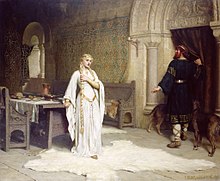
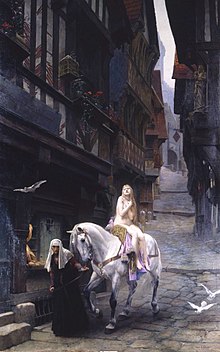
Lady Godiva: Edmund Blair Leighton depicts the moment of decision (1892)

Historical figure
Lady Godiva was the wife of Leofric, Earl of Mercia. Her name occurs in charters and the Domesday survey, though the spelling varies. The Old English name Godgifu or Godgyfu meant "gift of God"; Godiva was the Latinised version. Since the name was a popular one, there are contemporaries of the same name.[1][2]

Lady Godiva statue by Sir William Reid Dick unveiled at midday on 22 October 1949 in Broadgate, Coventry, a £20,000 gift from Mr WH Bassett-Green, a Coventrian.[13] (photo 2005)

If she was the same Godgifu who appears in the history of Ely Abbey, the Liber Eliensis, written at the end of 12th century, then she was a widow when Leofric married her. Both Leofric and Godiva were generous benefactors to religious houses. In 1043 Leofric founded and endowed a Benedictine monastery at Coventry.[3] Writing in the 12th century, Roger of Wendover credits Godiva as the persuasive force behind this act. In the 1050s, her name is coupled with that of her husband on a grant of land to the monastery of St Mary, Worcester and the endowment of the minster at Stow St Mary, Lincolnshire.[4][5] She and her husband are commemorated as benefactors of other monasteries at Leominster, Chester, Much Wenlock and Evesham.[6] She gave Coventry a number of works in precious metal made for the purpose by the famous goldsmith Mannig, and bequeathed a necklace valued at 100 marks of silver.[7] Another necklace went to Evesham, to be hung around the figure of the Virgin accompanying the life-size gold and silver rood she and her husband gave, and St Paul's Cathedral, London received a gold-fringed chasuble.[8] She and her husband were among the most munificent of the several large Anglo-Saxon donors of the last decades before the Conquest; the early Norman bishops made short work of their gifts, carrying them off to Normandy or melting them down for bullion.[9]

The manor of Woolhope in Herefordshire, along with three others, was given to the cathedral at Hereford before the Norman Conquest by the benefactresses Wulviva and Godiva – usually held to be this Godiva and her sister. The church there has a 20th century stained glass window representing them.[10]

Her mark, di Ego Godiva Comitissa diu istud desideravi, appears on a charter purportedly given by Thorold of Bucknall to the Benedictine monastery of Spalding. However, this charter is considered spurious by many historians.[11] Even so it is possible that Thorold, who appears in the Domesday Book as sheriff of Lincolnshire, was her brother.

After Leofric's death in 1057, his widow lived on until sometime between the Norman Conquest of 1066 and 1086. She is mentioned in the Domesday survey as one of the few Anglo-Saxons and the only woman to remain a major landholder shortly after the conquest. By the time of this great survey in 1086, Godiva had died, but her former lands are listed, although now held by others.[12] Thus, Godiva apparently died between 1066 and 1086.[1]

The place where Godiva was buried has been a matter of debate. According to the Chronicon Abbatiae de Evesham, or Evesham Chronicle, she was buried at the Church of the Blessed Trinity at Evesham, which is no longer standing. But, according to the authoritative account in the Oxford Dictionary of National Biography, "There is no reason to doubt that she was buried with her husband at Coventry, despite the assertion of the Evesham chronicle that she lay in Holy Trinity, Evesham."[1]

Dugdale (1656) says that a window with representations of Leofric and Godiva was placed in Trinity Church, Coventry, about the time of Richard II.

Legend
According to the popular story,[14][15] Lady Godiva took pity on the people of Coventry, who were suffering grievously under her husband's oppressive taxation. Lady Godiva appealed again and again to her husband, who obstinately refused to remit the tolls. At last, weary of her entreaties, he said he would grant her request if she would strip naked and ride through the streets of the town. Lady Godiva took him at his word and, after issuing a proclamation that all persons should stay indoors and shut their windows, she rode through the town, clothed only in her long hair. Only one person in the town, a tailor ever afterwards known as Peeping Tom, disobeyed her proclamation in one of the most famous instances of voyeurism.[16] In the story, Tom bores a hole in his shutters so that he might see Godiva pass, and is struck blind.[17] In the end, Godiva's husband keeps his word and abolishes the onerous taxes.

The oldest form of the legend has Godiva passing through Coventry market from one end to the other while the people were assembled, attended only by two knights.[18] This version is given in Flores Historiarum by Roger of Wendover (died 1236), a somewhat gullible collector of anecdotes, who quoted from an earlier writer. The later story, with its episode of "Peeping Tom," appeared first among 17th century chroniclers.
At the time, it was customary for penitents to make a public procession in only their shift, a sleeveless white garment similar to a slip today and one which was certainly considered "underwear." Thus, some scholars speculate, Godiva may have actually travelled through town as a penitent, in her shift. Godiva's story may have passed into folk history to be recorded in a romanticised version. Another theory has it that Lady Godiva's "nakedness" may refer to her riding through the streets stripped of her jewellery, the trademark of her upper class rank. However, both these attempts to reconcile known facts with legend are weak; there is no known use of the word "naked" in the era of the earliest accounts to mean anything other than "without any clothing whatsoever."[19]

Moreover, there is no trace of any version of the story in sources contemporary with Godiva, a story that would certainly have been recorded even in its most tame interpretations. Additionally, with the founding of Coventry circa 1043, there was little opportunity for the city to have developed to an extent that would have supported such a noble gesture. Lastly, the only recorded tolls were on horses. Thus, it remains doubtful whether there is any historical basis for the famous ride.

Like the story of Peeping Tom, the claim that Godiva's long hair effectively hid her nakedness from sight is generally believed to have been a later addition (cf. Rapunzel)[citation needed]. Certain other thematic elements are familiar in myth and fable: the resistant Lord (cf. Esther and Ahasuerus), the exacted promise, the stringent condition and the test of chastity. Even if Peeping Tom is a late addition, his being struck blind demonstrates the closely knit themes of the violated mystery and the punished intruder (cf. Diana and Actaeon)
Notes
1.^ a b c Ann Williams, ‘Godgifu (d. 1067?)’, Oxford Dictionary of National Biography, Oxford University Press, Sept 2004; online edn, Oct 2006 accessed 18 April 2008
2.^ "Lady Godiva, the book, and Washingborough", Lincolnshire Past and Present, 12 (1993), pp. 9–10.
3.^ Anglo-Saxons.net, S 1226
4.^ Anglo-Saxons.net, S 1232
5.^ Anglo-Saxons.net, S 1478
6.^ The Chronicle of John of Worcester ed. and trans. R.R. Darlington, P. McGurk and J. Bray (Clarendon Press: Oxford 1995), pp.582–583
7.^ Dodwell, C. R.; Anglo-Saxon Art: A New Perspective, 1982, Manchester UP, ISBN 071900926X (US edn. Cornell, 1985), p. 25 & 66
8.^ Dodwell, 180 & 212
9.^ Dodwell, 220, 230 & passim
10.^ flickr.com
11.^ Anglo-Saxons.net, S 1230
12.^ K.S.B.Keats-Rohan, Domesday People: A prosopography of persons occurring in English documents 1066–1166, vol. 1: Domesday (Boydell Press: Woodbridge, Suffolk 1999), p. 218
13.^ Douglas, Alton (February 1991). Coventry: A Century of News. Coventry Evening Telegraph. p. 62. ISBN 0902464361.
14.^ Joan Cadogan Lancaster. Godiva of Coventry. With a chapter on the folk tradition of the story by H.R. Ellis Davidson. Coventry [Eng.] Coventry Corp., 1967. OCLC 1664951
15.^ K. L. French, ‘The legend of Lady Godiva’, Journal of Medieval History, 18 (1992), 3–19
16.^ Lady Godiva, Historic-UK.com
17.^ "The Historical Godiva", Octavia Randolph
18.^ "Lady Godiva (Godgifu)", Flowers of History, University of California San Francisco
19.^ The Naked Truth, BBC News 2001

Legend

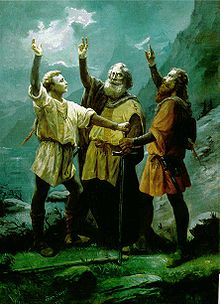
A depiction of the legendary Rütlischwur.

A legend (Latin, legenda, "things to be read [on a certain day, in church]") in the narrow sense is a Christian hagiographical account, often collected in a legendary (legendarium). Because saints' lives are often embellished with many miracle stories, "legend" in a wider sense came to refer to any story that is set in a historical context but that contains non-historical or fantastic elements. The Brothers Grimm defined legend as folktale historically grounded.[1] A modern folklorist's professional definition of legend was proposed by Timothy R. Tangherlini in 1990:[2]

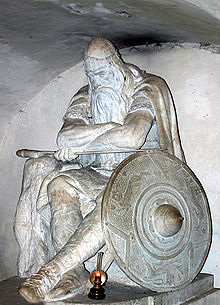
Holger Danske, a legendary character.

Legend, typically, is a short (mono-) episodic, traditional, highly ecotypified[3] historicized narrative performed in a conversational mode, reflecting on a psychological level a symbolic representation of folk belief and collective experiences and serving as a reaffirmation of commonly held values of the group to whose tradition it belongs."
Etymology and origin
The word "legend" appeared in the English language circa 1340, transmitted from mediaeval Latin language through French.[4] Its blurred extended (and essentially Protestant) sense of a non-historical narrative or myth was first recorded in 1613. By emphasizing the unrealistic character of "legends" of the saints, English-speaking Protestants were able to introduce a note of contrast to the "real" saints and martyrs of the Reformation, whose authentic narratives, they were sure, could be found in Foxe's Book of Martyrs.[5] Thus "legend" gained its modern connotations of "undocumented" and "spurious". Before the invention of the printing press, stories were passed on via oral tradition. Storytellers learned their stock in trade: their stories, typically received from an older storyteller, who might, though more likely not, have claimed to have actually known a witness, rendered the narrative as "history". Legend is distinguished from the genre of chronicle by the fact that legends apply structures that reveal a moral definition to events, providing meaning that lifts them above the repetitions and constraints of average human lives and giving them a universality that makes them worth repeating through many generations. In German-speaking and northern European countries, "legend", which involves Christian origins, is distinguished from "Saga", being from any other (usually, but not necessarily older) origin.

The modern characterisation of what may be termed a "legend" may be said to begin 1866 with Jacob Grimm's observation, "The fairy tale is poetic, legend, historic." [6] Early scholars such as Karl Wehrhahn[7] Friedrich Ranke[8] and Will-Erich Peukert[9] followed Grimm's example in focussing solely on the literary narrative, an approach that was enriched particularly after the 1960s ,[10] by addressing questions of performance and the anthropological and psychological insights provided in considering legends' social context. Questions of categorising legends, in hopes of compiling a content-based series of categories on the line of the Aarne-Thompson folktale index, provoked a search for a broader new synthesis.

In an early attempt at defining some basic questions operative in examining folk tales, Friedrich Ranke in 1925[11] characterised the folk legend as "a popular narrative with an objectively untrue imaginary content" a dismissive position that was subsequently largely abandoned.[12]

Compared to the highly-structured folktale, legend is comparatively amorphous, Helmut de Boor noted in 1928.[13] The narrative content of legend is in realistic mode, rather than the wry irony of folktale;[14] Wilhelm Heiske[15] remarked on the similarity of motifs in legend and folktale and concluded that, in spite of its realistic mode, legend is not more historical than folktale.

Legend is often considered in connection with rumour, also believable and concentrating on a single episode. Ernst Bernheim suggested that legend is simply the survival of rumour.[16] Gordon Allport credited the staying-power of certain rumours to the persistent cultural state-of-mind that they embody and capsulise;[17] thus "Urban legends" are a feature of rumour.[18] When Willian Jansen suggested that legends that disappear quickly were "short-term legends" and the persistent ones be termed "long-term legends", the distinction between legend and rumour was effectively obliterated, Tangherlini concluded.[19]

Related concepts
Legends are tales that, because of the tie to a historical event or location, are believable, although not necessarily believed. For the purpose of the study of legends, in the academic discipline of folkloristics, the truth value of legends is irrelevant because, whether the story told is true or not, the fact that the story is being told at all allows scholars to use it as commentary upon the cultures that produce or circulate the legends.
Hippolyte Delehaye, (in his Preface to The Legends of the Saints: An Introduction to Hagiography, 1907) distinguished legend from myth: "The legend, on the other hand, has, of necessity, some historical or topographical connection. It refers imaginary events to some real personage, or it localizes romantic stories in some definite spot."

In the painting of Lady Godiva by Jules Joseph Lefebvre, the authentic historical person is fully submerged in the legend, presented in an anachronistic high mediaeval setting.

From the moment a legend is retold as fiction its authentic legendary qualities begin to fade and recede: in The Legend of Sleepy Hollow, Washington Irving transformed a local Hudson River Valley legend into a literary anecdote with "Gothic" overtones, which actually tended to diminish its character as genuine legend.

Stories that exceed these boundaries of "realism" are called "fables". For example, the talking animal formula of Aesop identifies his brief stories as fables, not legends. The parable of the Prodigal Son would be a legend if it were told as having actually happened to a specific son of a historical father. If it included an ass that gave sage advice to the Prodigal Son it would be a fable.

Legend may be transmitted orally, passed on person-to-person, or, in the original sense, through written text. Jacob de Voragine's Legenda Aurea or "The Golden Legend" comprises a series of vitae or instructive biographical narratives, tied to the liturgical calendar of the Roman Catholic Church. They are presented as lives of the saints, but the profusion of miraculous happenings and above all their uncritical context are characteristics of hagiography. The Legenda was intended to inspire extemporized homilies and sermons appropriate to the saint of the day.
References
1.^ Norbert Krapf, Beneath the Cherry Sapling: Legends from Franconia (New York: Fordham University Press) 1988, devotes his opening section to distinguishing the genre of legend from other narrative forms, such as fairy tale; he "reiterates the Grimms' definition of legend as a folktale historically grounded", according to Hans Sebald's review in German Studies Review 13.2 (May 1990), p 312.
2.^ Tangherlini, "'It Happened Not Too Far from Here...': A Survey of Legend Theory and Characterization" Western Folklore 49.4 (October 1990:371-390) p. 85.
3.^ That is to say, specifically located in place and time.
4.^ OED, s.v. "Legend"
5.^ Patrick Collinson. Elizabethans, "Truth and Legend: The Veracity of John Foxe's Book of Martyrs" 2003:151-77, balances the authentic records and rhetorical presentation of Foxe's Acts and Monuments, itself a mighty force of Protestant legend-making. Sherry L. Reames, The Legenda Aurea: a reexamination of its paradoxical history, 1985, examines the "Renaissance verdict" on the Legenda, and its wider influence in skeptical approaches to Catholic hagiography in general.
6.^ "Das Märchen ist poetischer, die Sage, historischer"; quoted at the commencement of Tangherlini's survey of legend scholarship (Tangherlini 1990:371), which is in large part the basis of this section.
7.^ Wehrhahn Die Sage (Leipzig) 1908.
8.^ Ranke, "Grundfragen der Volkssagen Forshung", in Leander Petzoldt (ed.), Vergleichende Sagenforschung 1971:1-20, noted by Tangherlini 1990.)
9.^ Peukert , Sagen (Munich: E Schmidt) 1965.
10.^ Stimulated in part, Tangherlini suggests, by the 1962 congress of the International Society for Folk Narrative Research.
11.^ Ranke, "Grundfragen der Volkssagenforschung", Niederdeutsche Zeitschrift fur Volkskunde 3 (1925, reprinted 1969)
12.^ Charles L. Perdue Jt., reviewing Linda Dégh and Andrew Vászony's essay "The crack on the red goblet or truth and the modern legend" in Richard M. Dorson, ed. Folklore in the Modern World, (The Hague: Mouton)1978, in The Journal of American Folklore 93 No. 369 (July-September 1980:367), remarked on Ranke's definition, criticised in the essay, as a "dead issue". A more recent examination of the balance between oral performance and literal truth at work in legends forms Gillian Bennett's chaprer "Legend: Performance and Truth" in Gillian Bennett and Paul Smith, eds. Contemporary Legend (Garland) 1996:17-40.
13.^ de Boor, "Märchenforschung", Zeitschrift für Deutschkunde 42 1928:563-81.
14.^ Lutz Röhrich, Märchen und Wirklichkeit: Eine volkskundliche Untersuchung (Wiesbaden: Steiner Verlag) 1956:9-26.
15.^ Heiske, "Das Märchen ist poetischer, die Sage, historischer: Versuch einer Kritik", Deutschunterricht14 1962:69-75..
16.^ Bernheim, Einleitung in der Geschichtswissenschaft(Berlin: de Gruyter) 1928.
17.^ Allport, The Psychology of Rumor (New York: Holt, Rinehart) 1947:164.
18.^ Bengt af Klintberg, "Folksägner i dag" Fataburen 1976:269-96.
19.^ Jansen, "Legend: oral tradition in the modern experience", Folklore Today, A Festschrift for William Dorson (Bloomington: Indiana University Press) 1972:265-72, noted in Tangherlini 1990:375.
Hippolyte Delehaye, The Legends of the Saints: An Introduction to Hagiography (1907), Chapter I: Preliminary Definitions, et passim
Karl Kerenyi, The Heroes of the Greeks (1959)
Catholic Encyclopedia article Literary or Profane Legends
Timothy R. Tangherlini, "'It Happened Not Too Far from Here...': A Survey of Legend Theory and Characterization" Western Folklore 49.4 (October 1990:371-390). A condensed survey with extensive bibliography.

Lucifer

Lucifer

Gallery


Lucifer is a Latin word (from the words lucem ferre), literally meaning "light-bearer", which in that language is used as a name for the dawn appearance of the planet Venus, heralding daylight. Use of the word in this sense is uncommon in English, in which "Day Star" or "Morning Star" are more common expressions.

In English, "Lucifer" generally refers to the Devil, although the name is not applied to him in the New Testament. The use of the name "Lucifer" in reference to a fallen angel stems from an interpretation of Isaiah 14:3–20, a passage that speaks of a particular Babylonian King, to whom it gives a title that refers to what in English is called the Day Star or Morning Star (in Latin, lucifer),[2] as fallen or destined to fall from the heavens or sky.[3] In 2 Peter 1:19 and elsewhere, the same Latin word lucifer is used to refer to the Morning Star, with no relation to the devil. However, in post-New Testament times the Latin word Lucifer has often been used as a name for the devil, both in religious writing and in fiction, especially when referring to him before he fell from Heaven.
Satan as Lucifer
The Lucifer story

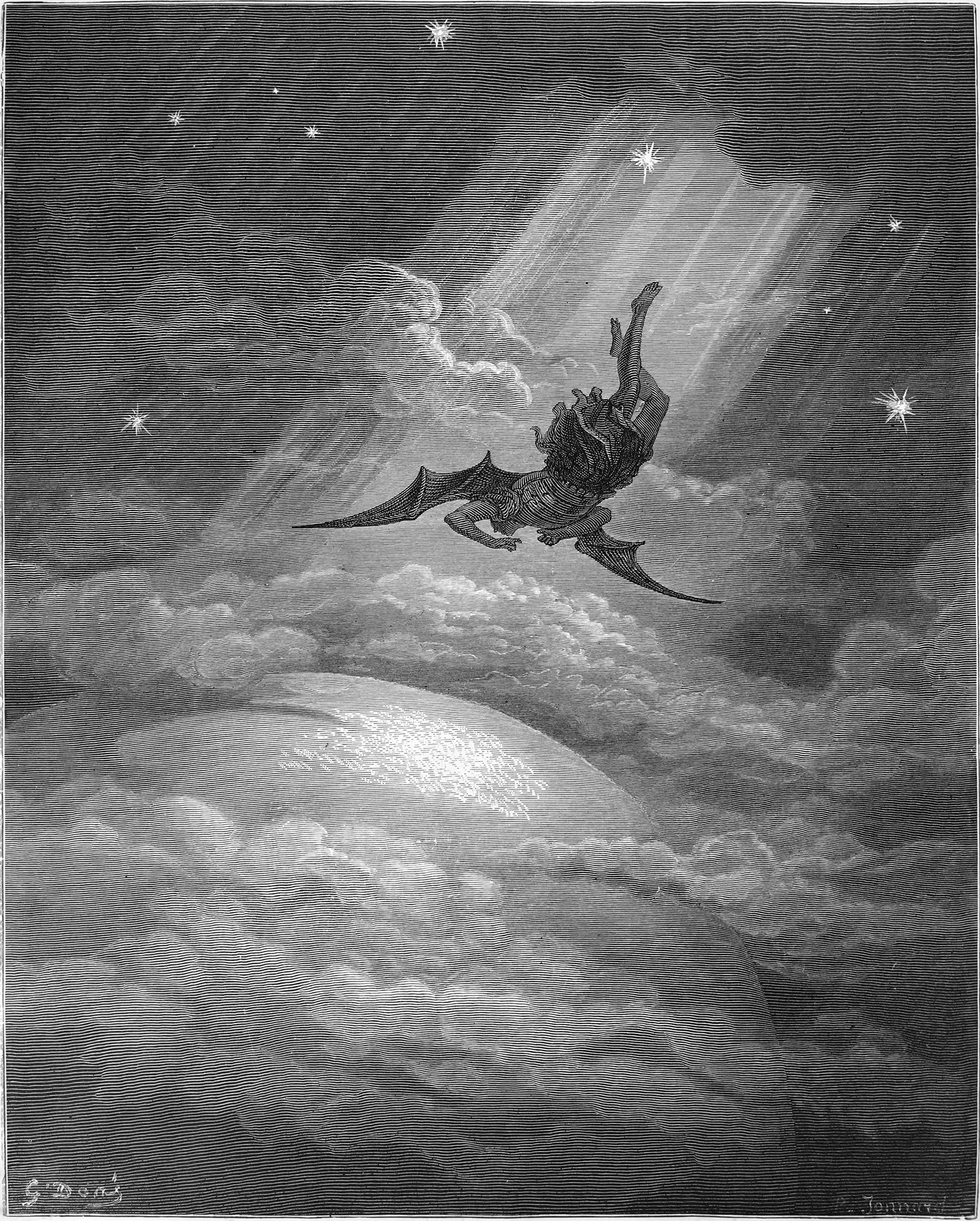
A myth[4] of the fall of angels, associated with the Morning Star, was transferred to Satan, as seen in the Life of Adam and Eve and the Second Book of Enoch,[5] which the Jewish Encyclopedia attributes to the first pre-Christian century:[6] in these Satan-Sataniel (sometimes identified with Samael) is described as having been one of the archangels. Because he contrived "to make his throne higher than the clouds over the earth and resemble 'My power' on high", Satan-Sataniel was hurled down, with his hosts of angels, and since then he has been flying in the air continually above the abyss.[4]
Early Christian writers continued this identification of "Lucifer" with Satan. Tertullian ("Contra Marcionem," v. 11, 17), Origen (Homilies on Ezekiel 13), and others, identify Lucifer with Satan, who also is represented as being "cast down from heaven" (Revelation 12:7–10; cf. Luke 10:18).[4]

However, some contemporary exorcists and theologians such as Father José Antonio Fortea and Father Amorth in their experience and based on Biblical interpretations assert that Lucifer and Satan are different beings.[7]

In the New Testament the Adversary has many names, but "Lucifer" is not among them. He is called "Satan" (Matt. 4:10; Mark 1:13, 4:15; Luke 10:18), "devil" (Matt. 4:1), "adversary" (1. Peter 5:8, ἀντίδικος; 1. Tim. 5:14, ἀντικείμενος), "enemy" (Matt. 13:39), "accuser" (Rev. 12:10), "old serpent" (Rev. 20:2), "great dragon" (Rev. 12:9), Beelzebub (Matt. 10:25, 12:24), and Belial (comp. Samael). In Luke 10:18, John 12:31, 2. Cor. 6:16, and Rev. 12:9 the fall of Satan is mentioned. The devil is regarded as the author of all evil (Luke 10:19; Acts 5:3; 2. Cor. 11:3; Ephes. 2:2), who beguiled Eve (2. Cor. 11:3; Rev. 12:9). Because of Satan, death came into this world, being ever the tempter (1. Cor. 7:5; 1. Thess. 3:5; 1. Peter 5:8), even as he tempted Jesus (Matt. 4). The Christian demonology and belief in the devil dominated subsequent periods.[8] However, though the New Testament includes the conception that Satan fell from heaven "as lightning" (Luke 10:18; Rev. 12:7-10),[9] it nowhere applies the name Lucifer to him.

The Jewish Encyclopedia states that in the apocalyptic literature, the conception of fallen angels is widespread. Throughout antiquity stars were commonly regarded as living celestial beings (Job 38:7).[9] Indications of this belief in fallen angels, behind which probably lies the symbolizing of an astronomical phenomenon, the shooting stars, are found in Isaiah 14:12.
The Morning Star in Isaiah 14:12

The Book of Isaiah has the following passage:

    When the Lord has given you rest from your pain and turmoil and the hard service with which you were made to serve, you will take up this taunt against the king of Babylon: How the oppressor has ceased! How his insolence has ceased! … How you are fallen from heaven, O Day Star, son of Dawn! How you are cut down to the ground, you who laid the nations low! You said in your heart, "I will ascend to heaven; I will raise my throne above the stars of God; I will sit on the mount of congregation on the heights of Zaphon; I will ascend to the tops of the clouds, I will make myself like the Most High." But you are brought down to Sheol, to the depths of the Pit. Those who see you will stare at you, and ponder over you: "Is this the man who made the earth tremble, who shook kingdoms, who made the world like a desert and overthrew its cities, who would not let his prisoners go home?[10]

The passage refers to the king of Babylon, a man who seemed all-powerful, but who has been brought down to the abode of the dead ("Sheol"). Isaiah promises that the Israelites will be freed and will then be able to use in a taunting song against their oppressor the image of the Morning Star, which rises at dawn as the brightest of the stars, outshining Jupiter and Saturn, but lasting only until the sun appears. This image was used in an old popular Canaanite story that the Morning Star tried to rise high above the clouds and establish himself on the mountain where the gods assembled, in the far north, but was cast down into the underworld.[4][11]

The phrase "O Day Star, son of Dawn" in the New Revised Standard Version translation given above corresponds to the Hebrew phrase "הילל בן־שׁחר" (Helel Ben-Shachar) in verse 12, meaning "morning star, son of dawn". As the Latin poets personified the Morning Star and the Dawn (Aurora), as well as the Sun and the Moon and other heavenly bodies, so in Canaanite mythology Morning Star and Dawn were pictured as two deities, the former being the son of the latter.[12]

In the Latin Vulgate, Jerome translated "הילל בן־שׁחר" (morning star, son of dawn) as "lucifer qui mane oriebaris" (morning star that used to rise early).[13] Already, as early as the Christian writers Tertullian and Origen,[11] the whole passage had come to be applied to Satan. Satan began to be referred to as "Lucifer" (Morning Star), and finally the word "Lucifer" was treated as a proper name. The use of the word "Lucifer" in the 1611 King James Version instead of a word such as "Daystar" ensured its continued popularity among English speakers.

Most modern English versions (including the NIV, NRSV, NASB, NJB and ESV) render the Hebrew word as "day star", "morning star" or something similar, and never as "Lucifer", a word that in English is now very rarely used in the sense of the original word in Hebrew (Morning Star), though in Latin "Lucifer" was a literal translation.

A passage quite similar to that in Isaiah is found in Ezekiel 28:1–19, which is expressly directed against the king of Tyre, a city on an island that had grown rich by trade, factors alluded to in the text.[14] In Christian tradition, it too has been applied to Lucifer, because of some of the expressions contained in it.[15] But, since it does not contain the image of the Morning Star, discussion of it belongs rather to the article on Satan than to that on Lucifer.
The same holds for the Christian depiction of Satan in other books of the Old Testament as, for instance, in the Book of Job, where Satan, who has been wandering the Earth, has a discussion with God and makes a deal with him to test Job.

The Tyndale Bible Dictionary states that there are many who believe the expression "Lucifer" and the surrounding context in Isaiah 14 refer to Satan: they believe the similarities among Isaiah 14:12, Luke 10:18, and Revelation 12:7–10 warrant this conclusion. But it points out that the context of the Isaiah passage is about the accomplished defeat of the king of Babylon, while the New Testament passages speak of Satan.[11]
Islamic point of view

According to the Qur'an, Iblis (the Arabic name used) disobeyed an order from Allah to bow to Adam and as a result was forced out of heaven and given respite until the day of judgment from further punishment.

When Allah commanded all of the angels to bow down before Adam (the first Human), Iblis, full of hubris and jealousy, refused to obey Allah's command (he could do so because, as a jinn, he had free will), seeing Adam as being inferior in creation due to his being created from clay as compared to him (created of fire).[16]

    "It is We Who created you and gave you shape; then We bade the angels prostrate to Adam, and they prostrate; not so Iblis (Lucifer); He refused to be of those who prostrate."
    (Allah) said: "What prevented thee from prostrating when I commanded thee?" He said: "I am better than he: Thou didst create me from fire, and him from clay."

        Qur'an 7:11–12

It was after this that the title of "Shaitan" was given, which can be roughly translated as "Mischievous" or "Devil". Shaitan then claims that if the punishment for his act of disobedience is to be delayed until the Day of Judgment, that he will divert many of Adam's own descendants from the straight path during his period of respite.[17] Allah accepts the claims of Iblis and guarantees recompense to Iblis and his followers in the form of Hellfire. To test mankind and jinn alike, Allah allowed Iblis to roam the Earth to attempt to convert others away from his path.[18] He was sent to Earth along with Adam and Eve, after eventually luring them into eating the fruit from the forbidden tree.[19]
Other readings

Joseph Campbell (1972: pp. 148–149) illustrates an unorthodox Islamic reading of Lucifer's fall from Heaven, which champions Lucifer's eclipsing love for God:

    One of the most amazing images of love that I know is in Persian – a mystical Persian representation as Satan as the most loyal lover of God. You will have heard the old legend of how, when God created the angels, he commanded them to pay worship to no one but himself; but then, creating man, he commanded them to bow in reverence to this most noble of his works, and Lucifer refused – because, we are told, of his pride. However, according to this Muslim reading of his case, it was rather because he loved and adored God so deeply and intensely that he could not bring himself to bow before anything else, and because he refused to bow down to something inferior to him (since he was made of fire, and man from clay). And it was for that that he was flung into Hell, condemned to exist there forever, apart from his love.

This interpretation of the satanic rebellion described in the Quran is seen by some Sufi teachers such as Mansur Al-Hallaj (in his 'Tawasin') as a predestined scenario in which Iblis-Shaitan plays the role of tragic and jealous lover who, unable to perceive the Divine Image in Adam and capable only of seeing the exterior, disobeyed the divine mandate to bow down. His refusal (according to the Tawasin) was due to a misconceived idea of God's uniqueness and because of his refusal to abandon himself to God in love. Hallaj criticized the staleness of Iblis' adoration. Excerpts from Sufi texts expounding this interpretation have been included along with many other viewpoints on Shaitan (by no means all of them apologetic) in an important anthology of Sufi texts edited by Dr. Javad Nurbakhsh, head of the Nimatullahi Sufi Order.[20]

The Sufi teacher Pir Vilayat Inayat Khan taught that 'Luciferian Light' is Light that has become dislocated from the Divine Source and is thus associated with the seductive false light of the lower ego, which lures humankind into self-centered delusion.[21] Here Lucifer represents what the Sufis term the 'Nafs', the ego.
Use of the word "lucifer" in the Bible

The Vulgate (Latin) version of the Christian Bible used the word "lucifer" (with lower-case initial) twice to refer to the Morning Star: once in 2 Peter 1:19 to translate the Greek word Φωσφόρος, a word, from φῶς (light), that has exactly the same meaning of Light-Bringer that the Latin word has, and once in Isaiah 14:12 to translate the Hebrew word הילל (Hêlēl).[22] In the latter passage the title of "Morning Star" is given to the tyrannous Babylonian king, who the prophet says is destined to fall. This passage was later applied to the prince of the demons, and so the name "Lucifer" came to be used outside the Bible for the devil, and was popularized in works such as Dante Alighieri's Inferno and John Milton's Paradise Lost, but for English speakers the greatest influence has been its use in the King James Version of Isa 14:12 to translate the Hebrew word הילל, which more modern English versions render as "Morning Star" or "Day Star". A similar passage in Ezekiel 28:11–19 regarding the "king of Tyre" was also applied to the devil, contributing to the traditional picture of the fallen angel.

The Vulgate translation uses "lucifer" (Morning Star) twice to translate words in the Book of Job that meant something different: once to represent the word "בקר"[23] (which instead means "morning") in Job 11:17, and once for the word "מזרות" (usually taken to mean "the constellations") in Job 38:32. The same Latin word appears also in the Vulgate version of Psalms 110:3, where the original has "שׁחר" (dawn, the same word as in Isaiah 14:12).

The Vulgate did not use the Latin word lucifer to represent the two references to the Morning Star in the Book of Revelation . In both cases the original Greek text uses a circumlocution instead of the single word "φωσφόρος", and a corresponding circumlocution is used in the Latin. Thus "stella matutina" is used for "ὁ ἀστὴρ ὁ πρωϊνός" in Revelation 2:28, which promises the Morning Star to those who persevere, and for "ὁ ἀστὴρ ὁ πρωϊνός" (or, according to some manuscripts, "ὁ ἀστὴρ ὁ ὀρθρινός") in Revelation 22:16, where Jesus calls himself "the bright morning star".

The English word "Lucifer" is used in none of these places (other than Isaiah 14:12), where the Latin translation uses the Latin word "lucifer" (i.e., morning star).

Outside the Bible, the Roman Rite liturgy's Exultet chant in praise of the paschal candle refers to Christ as the Morning Star (in Latin, lucifer, with lower-case initial):

May the Morning Star which never sets
find this flame still burning:
Christ, that Morning Star,
who came back from the dead,
and shed his peaceful light on all mankind,
your Son, who lives and reigns for ever and ever.
   

Flammas eius lucifer matutinus inveniat:
ille, inquam, lucifer, qui nescit occasum,
Christus Filius tuus qui,
regressus ab inferis,
humano generi serenus illuxit,
et vivit et regnat in saecula saeculorum.
Astronomical significance

Because the planet Venus is an inferior planet, meaning that its orbit lies between the orbit of the Earth and the Sun, it can never rise high in the sky at night as seen from Earth. It can be seen in the eastern morning sky for an hour or so before the Sun rises, and in the western evening sky for an hour or so after the Sun sets, but never during the dark of midnight.

It is the brightest object in the sky after the Sun and the Moon. As bright and as brilliant as it is, ancient people did not understand why they could not see it at midnight like the outer planets, or during midday, like the Sun and Moon. It outshines the planets Saturn and Jupiter, which do last all night, but it soon disappears. Canaanite mythology has a story of an unsuccessful attempt by Athtar, the Morning Star pictured as a god, to take over the throne of Baal.[24][25]
"Lucifer" as Latin name for the Morning Star

In Latin, the word "Lucifer", meaning "Light-Bringer" (from lux, lucis, "light", and ferre, "to bear, bring"), is a name used for the Morning Star (the planet Venus in its dawn appearances).[26] The word is used in its astronomical sense both in prose[27] and poetry,[28] but most poets personify the star in a mythological context.[29]
The Taxil Hoax: Lucifer's alleged connection with Freemasonry

Léo Taxil (1854–1907) claimed that Freemasonry is associated with worshipping Lucifer. In what is known as the Taxil hoax, he claimed that supposedly leading Freemason Albert Pike had addressed "The 23 Supreme Confederated Councils of the world" (an invention of Taxil), instructing them that Lucifer was God, and was in opposition to the evil god Adonai. Apologists of Freemasonry contend that, when Albert Pike and other Masonic scholars spoke about the "Luciferian path," or the "energies of Lucifer," they were referring to the Morning Star, the light bearer,[30] the search for light; the very antithesis of dark, satanic evil. Taxil promoted a book by Diana Vaughan (actually written by himself, as he later confessed publicly)[31] that purported to reveal a highly secret ruling body called the Palladium, which controlled the organization and had a Satanic agenda. As described by Freemasonry Disclosed in 1897:

    With frightening cynicism, the miserable person we shall not name here [Taxil] declared before an assembly especially convened for him that for twelve years he had prepared and carried out to the end the most sacrilegious of hoaxes. We have always been careful to publish special articles concerning Palladism and Diana Vaughan. We are now giving in this issue a complete list of these articles, which can now be considered as not having existed.[32]

Taxil's work and Pike's address continue to be quoted by anti-masonic groups.[33]

In Devil-Worship in France, Arthur Edward Waite compared Taxil's work to what today we would call a tabloid story, replete with logical and factual inconsistencies.

See also "Lucifer and Satan" at the Grand Lodge of British Columbia and Yukon website.
Occult beliefs
In the modern occultism of Dolores North (alias Madeline Montalban) (died 1982)[35] Lucifer's identification as the Morning Star (Venus) equates him with Lumiel, whom she regarded as the Archangel of Light, and among Satanists he is seen as the "Torch of Baphomet" and Azazel.

In the Satanic Bible of 1969, Lucifer is acknowledged as one of the Four Crown Princes of Hell, particularly that of the East. Lord of the Air, Lucifer has been named "Bringer of Light, the Morning Star, Intellectualism, Enlightenment."

Author Michael W. Ford[36] has written on Lucifer as a "mask" of the Adversary, a motivator and illuminating force of the mind and subconscious.[37]

شیطان

کلمه شیْطان از ماده «شطن» گرفته شده، و «شاطن» به معنای «خبیث و پست» آمده‌است، و شیطان به موجود رانده شده، سرکش و متمرد اطلاق می‌شود و به معنی روح شریر و دور از حق، نیز آمده‌است.

«شیطان» اسم عام (اسم جنس) است، در حالی که «ابلیس» اسم خاص (عَلَم) می‌باشد، و به عبارت دیگر شیطان به هر موجود موذی و منحرف کننده و طاغی و سرکش، خواه انسانی یا غیر انسانی می‌گویند، ونام ابلیس در باورهای اسلامی شیطان,به معنای کسی که ادم را فریب داده‌است.

شیطان به موجود موذی و مضر گفته می‌شود، موجودی که از راه راست بر کنار بوده و در صدد آزار دیگران است، موجودی که سعی می‌کند ایجاد دودستگی نماید، و اختلاف و فساد به راه اندازد، و اینکه به ابلیس هم شیطان اطلاق شده بخاطر فساد و شرارتی است که در او وجود دارد.

شیطان معانی مختلفی دارد، که یکی از مصداقهای روشن آن ابلیس و مصداق دیگر آن انسان‌های مفسد و منحرف کننده‌است.
تاریخ

براساس تفسیرهای قرآن و احادیث ٬شیطان یکی از جن‌ها بود که بر اثر پارسایی زیاد به درجه فرشتگان راه یافت و یکی از فرشتگان مقرب خدا شد(در حدیثی از جعفر صادق منقول است که یک بار شیطان نمازی خواند دو رکعت ولی ۱۰۰۰ سال طول کشید) اما برای سجده نکردن به آدم او از درگاه الهی رانده شد و به او فرصت داده شد تا وقت معلوم خداوند انسان را بفریبد[۱]
در هنر

در طول تاریخ شیطان در فیلم‌ها و داستان‌های زیادی شخصیت شده‌است
پانویس

   1. ↑ داستان‌های پیامبران جلد اول بخش مربوط به آدم
   2. ↑ مجله همشری جوان شماره ۱۳۶
Satan
Satan (Hebrew: הַשָׂטָן ha-Satan ("the accuser"); Arabic: الشيطان ash-Shayṭān ("the adversary") - both from the Semitic root: Ś-Ṭ-N) is an embodiment of antagonism that originates from the Abrahamic religions, being traditionally considered a "fallen" angel in Judeo-Christian belief, and a Jinn in Islamic belief. Originally, the term was used as a title for various entities (humans, accusing angels, etc.) that challenged the religious faith of humans in the Hebrew Bible.[1] Since then, the Abrahamic religions have used "Satan" as a name for the Devil.[2]
In Judaism
In the Hebrew Bible

In the book of Job (Iyov), ha-satan ("the accuser")is the title of an angel submitted to God. In Judaism ha-satan does not make evil, rather points out to God the evil inclinations and actions of humankind. In essence ha-satan has no power unless humans do evil things. After God places a wager with Satan about Job's piety, God gives "ha-satan" permission to test the faith of Job. The righteous man is afflicted with loss of family, property, and later, health, but he still stays faithful to God. At the conclusion of this book God appears in a whirlwind, explaining to all that divine justice is inscrutable. In the epilogue Job's possessions are restored and he has a second family to replace the one that died.

In the Torah, satan is used to describe both military (1 Sam 29:4; 1 Kings 5:4 (1 Kings 5:18 in a Jewish Bible)) and legal (Ps 109:6) adversaries. Satan is also in the Balaam's story in Numbers 22. The Angel of the LORD is identified as an adversary or a physical block to Balaam's journey in Numbers 22:22. Later in Numbers 22:32 the Angel of the LORD specifically identifies himself by claiming to be like an adversary, again using the term satan.

In 2 Samuel 24:1, Yahweh incites David to a census. Later 1 Chronicles 21:1, would attribute this action to satan.

The Book of Isaiah, Job, Ecclesiastes, and Deuteronomy all have passages in which God is credited for exercising sovereign control over both good and evil.
In the Hebrew Apocrypha

The Jewish apocrypha are religious writings which are not accepted as religious texts in Judaism, and many modern-day Protestant denominations. These works usually bore the names of ancient Hebrew worthies in order to establish their validity among the true writers' contemporaries. To reconcile the late appearance of the texts with their claims to primitive antiquity, alleged authors are represented as "shutting up and sealing" (Dan. XII. 4:9) the works until the time of their fulfillment had arrived; as the texts were not meant for their own generations but for far-distant ages (also cited in Assumption of Moses I. 16:17). In the Book of Wisdom, the devil is represented as the being who brought death into the world.[3]

The 2nd Book of Enoch, also called the Slavonic Book of Enoch, contains references to a Watcher Grigori called Satanael.[4] It is a pseudepigraphic text of an uncertain date and unknown authorship. The text describes Satanael as being the prince of the Grigori who was cast out of heaven[5] and an evil spirit who knew the difference between what was "righteous" and "sinful".[6] A similar story is found in the book of 1 Enoch; however, in that book, the leader of the Grigori is called Semjâzâ.

In the apocryphal literature, Satan rules over a host of angels.[7] Mastema, who induced God to test Abraham through the sacrifice of Isaac, is identical with Satan in both name and nature.[8]

For the Chasidic Jews of the eighteenth century, Ha-satan was Baal Davar.[9] The Book of Enoch contains references to Satariel, thought also to be Sataniel and Satan'el (etymology dating back to Babylonian origins). The similar spellings mirror that of his angelic brethren Michael, Raphael, Uriel and Gabriel, previous to his expulsion from Heaven.
In the Talmud and other rabbinic sources

The Talmud mentions the Satan in many places. In all of these places, the Satan is an agent of God, and has no independent existence. Sometimes the Satan is conflated with various demons, such as Asmodai. At times there is even some sympathy for him. Commenting on the Book of Job, the rabbis express sympathy that his job was to "break the barrel but not spill any wine."

In Kabbalistic literature and its derivative, Hasidic literature, the Satan is seen as an agent of God whose job is to tempt one into sin, and then turn around and accuse the sinner on high. An additional understanding of Satan is from a parable to a prostitute who is hired by the King (God) to tempt his son (a Jew). The prostitute has to do the best she can to tempt the son; but deep down she hopes the son will pass the test. Similarly, Kabbalistic/Hasidic thought sees the Satan in the same situation. His job is to tempt us as best he can; turn around and accuse us; but deep down his wish is that we would resist his blandishments.
In Christianity
In Christianity, terms that are synonymous with "Satan" include:

    * The most common English synonym for "Satan" is "Devil", which descends from Middle English devel, from Old English dēofol, that in turn represents an early Germanic borrowing of Latin diabolus (also the source of "diabolical"). This in turn was borrowed from Greek diabolos "slanderer", from diaballein "to slander": dia- "across, through" + ballein "to hurl".[10] In the New Testament, "Satan" occurs more than thirty times in passages alongside Diabolos (Greek for "the devil"), referring to the same person or thing as Satan.[11]
    * Lucifer is sometimes used in Christian theology to refer to Satan, as a result of identifying the fallen "son of the dawn" of Isaiah 14:12 with the "accuser" of other passages in the Old Testament.
    * Beelzebub is originally the name of a Philistine god (more specifically a certain type of Baal, from Ba‘al Zebûb, lit. "Lord of Flies") but is also used in the New Testament as a synonym for Satan. A corrupted version, "Belzeboub", appears in The Divine Comedy.
    * Satan is identified as the serpent who convinced Eve to eat the forbidden fruit; thus, Satan has often been depicted as a serpent. This interpretation goes back at least as far as the time of the writing of the book of Revelation, which specifically identifies Satan as being the serpent (Rev. 20:2).
    * "The dragon" and "the old serpent" in the Book of Revelation 12:9, 20:2 have been identified with Satan. The Book of Revelation also refers to "the deceiver," from which is derived the common epithet "the great deceiver."[12] Other terms identified with Satan include "the prince of this world" in the Book of John 12:31, 14:30; "the prince of the power of the air" also called Meririm, and "the spirit that now worketh in the children of disobedience" in the Book of Ephesians 2:2; and "the god of this world" in 2 Corinthians 4:4.[13]
    * Leviathan is described as "that crooked serpent", which is also used to describe Satan in Revelation 12:9. 'Sar ha Olam,' a possible name for Metatron, is described as Satan by Michael, Jehoel and St. Paul.
In mainstream Christianity's understanding of the holy Hebrew scriptures, the Torah, Satan is a synonym for the Devil. For most Christians, he is believed to be an angel who rebelled against God—and also the one who spoke through the serpent and seduced Eve into disobeying God's command. His ultimate goal is to lead people away from the love of God — to lead them to fallacies which God opposes. Satan is also identified as the accuser of Job, the tempter in the Gospels, the secret power of lawlessness in 2 Thessalonians 2:7, and the dragon in the Book of Revelation. Before his insurrection, Satan was among the highest of all angels and the "brightest in the sky". His pride is considered a reason why he would not bow to God as all other angels did, but sought to rule heaven himself. The popularly held beliefs that Satan was once a prideful angel who eventually rebels against God, however, are barely portrayed explicitly in the Bible and are mostly based on inference (e.g., Ezekiel 28 and Isaiah 14:12-17). In mainstream Christianity he is called "the ruler of the demons" (Matt. 12:24), "the ruler of the world" and "the god of this world". (2 Cor. 4:4). The Book of Revelation describes how Satan will be cast out of Heaven, down to the earth, having "great anger" and waging war against "those who obey God's commandments and hold to the testimony of Jesus". Ultimately, Satan is thrown into the "Lake of fire" (Revelation 20:10), not as ruler, but as one among many, being tormented day and night for all eternity.

In other Christian beliefs (e.g. the beliefs of the Christadelphians) the word "satan" in the Bible is not regarded as referring to a supernatural, personal being but to any "adversary" and figuratively refers to human sin and temptation.[14]
In Islam
Shaitan (شيطان) is the equivalent of Satan in Islam. While Shaitan (شيطان, from the root šṭn شطن) is an adjective (meaning "astray" or "distant", sometimes translated as "devil") that can be applied to both man ("al-ins", الإنس) and Jinn, Iblis (Arabic pronunciation: [ˈibliːs]) is the personal name of the Devil who is mentioned in the Qur'anic account of Genesis.[15] According to the Qur'an, Iblis (the Arabic name used) disobeyed an order from Allah to bow to Adam and as a result was forced out of heaven and given respite until the day of judgment from further punishment.

When Allah commanded all of the angels to bow down before Adam (the first Human), Iblis, full of hubris and jealousy, refused to obey God's command (he could do so because, as a jinn, he had free will), seeing Adam as being inferior in creation due to his being created from clay as compared to him (created of fire).[16]

    "It is We Who created you and gave you shape; then We bade the angels prostrate to Adam, and they prostrate; not so Iblis (Lucifer); He refused to be of those who prostrate."
    (Allah) said: "What prevented thee from prostrating when I commanded thee?" He said: "I am better than he: Thou didst create me from fire, and him from clay."

        Qur'an 7:11-12

It was after this that the title of "Shaitan" was given, which can be roughly translated as "Enemy," "Rebel," "Evil" or "Devil". Shaitan then claims that if the punishment for his act of disobedience is to be delayed until the Day of Judgment, that he will divert many of Adam's own descendants from the straight path during his period of respite.[17] God accepts the claims of Iblis and guarantees recompense to Iblis and his followers in the form of Hellfire. In order to test mankind and jinn alike, Allah allowed Iblis to roam the earth to attempt to convert others away from his path.[18] He was sent to earth along with Adam and Eve, after eventually luring them into eating the fruit from the forbidden tree.[19]
In other religions
Yazidism

An alternate name for the main deity in the tentatively Indo-European pantheon of the Yazidi, Malek Taus, is Shaitan.[20] Rather than Satanic, however, Yazidism is better understood as a remnant of a pre-Islamic Middle Eastern Indo-European religion, and/or a ghulat Sufi movement founded by Shaykh Adi. The connection with Satan, originally made by Muslim outsiders, attracted the interest of 19th-century European travelers and esoteric writers.
Bahá'í Faith

In the Bahá'í Faith, Satan is not regarded as an independent evil power as he is in some faiths, but signifies the lower nature of humans. `Abdu'l-Bahá explains: "This lower nature in man is symbolized as Satan—the evil ego within us, not an evil personality outside."[21][22] All other evil spirits described in various faith traditions such as fallen angels, demons and jinns are also metaphors for the base character traits a human being may acquire and manifest when he turns away from God.[23]
Satanism
Satanic groups have various opinions about Satan, ranging from the conviction that he exists and ought to be worshipped (theistic Satanism), to Anton Szandor LaVey's symbolic interpretation, which emphasizes individual will and pleasure-seeking.

Much "Satanic" lore does not originate from actual Satanists, but from Christians. Best-known is the medieval folklore and theology surrounding demons and witches. A more recent example is the so-called Satanic ritual abuse scare of the 1980s — beginning with the memoir Michelle Remembers — which depicts Satanism as a vast (and unsubstantiated) conspiracy of elites with a predilection for child abuse and human sacrifice. This genre regularly describes Satan as actually appearing in person in order to receive worship.
Notes

   1. ^ T. J. Wray, Gregory Mobley The birth of Satan: tracing the devil's biblical roots 2005 specifically ch.2 Unsystematic theology - the nature of God in the Hebrew Bible ch.3 The Devil is in the details - Satan in the Hebrew Bible
   2. ^ Scott (1999); Kelly (2006)
   3. ^ "But by the envy of the devil, death came into the world" - Book of Wisdom II. 24
   4. ^ 2 Enoch 18:3
   5. ^ "And I threw him out from the height with his angels, and he was flying in the air continuously above the bottomless" - 2 Enoch 29:4
   6. ^ "The devil is the evil spirit of the lower places, as a fugitive he made Sotona from the heavens as his name was Satanail, thus he became different from the angels, but his nature did not change his intelligence as far as his understanding of righteous and sinful things" - 2 Enoch 31:4
   7. ^ Martyrdom of Isaiah, 2:2; Vita Adæ et Evæ, 16)
   8. ^ Book of Jubilees, xvii. 18
   9. ^ The Dictionary of Angels" by Gustav Davidson, © 1967
  10. ^ "American Heritage Dictionary: Devil". http://www.bartleby.com/61/94/D0179400.html. Retrieved 2006-05-31.
  11. ^ Revelation 12:9
  12. ^ B. W. Johnson ([1891]). "The Revelation of John. Chapter XX. The Millennium.". The People's New Testament. Memorial University of Newfoundland. http://www.mun.ca/rels/restmov/texts/bjohnson/hg1/PNT27-20.HTM. Retrieved November 30, 2009.
  13. ^ 2 Corinthians 4:4
  14. ^ "Do you Believe in a Devil?". http://www.christadelphia.org/pamphlet/devil.htm. Retrieved 2007-05-29.
  15. ^ Iblis
  16. ^ [Qur'an 17:61]; [Qur'an 2:34]
  17. ^ [Qur'an 17:62]
  18. ^ [Qur'an 17:63-64]
  19. ^ [Qur'an 7:20-22]
  20. ^ Drower, E.S. The Peacock Angel. Being Some Account of Votaries of a Secret Cult and their Sanctuaries. London: John Murray, 1941. [1]
  21. ^ ʻAbduʾl-Bahá (1982) [1912]. The Promulgation of Universal Peace. Wilmette, Illinois, USA: Bahá'í Publishing Trust. p. 294-295. ISBN 0877431728. http://reference.bahai.org/en/t/ab/PUP/pup-97.html.
  22. ^ Smith, Peter (2000). A Concise Encyclopedia of the Bahá'í Faith. Oxford, UK: Oneworld. pp. 135-136, 304. ISBN 1851681841.
  23. ^ Smith, Peter (2008). An Introduction to the Baha'i Faith. Cambridge: Cambridge University Press. pp. 112. ISBN 0521862515.
References

    * Bamberger, Bernard J. (2006). Fallen Angels: Soldiers of Satan's Realm. Jewish Publication Society of America. ISBN 0-8276-0797-0.
    * Caldwell, William. "The Doctrine of Satan: I. In the Old Testament," The Biblical World, Vol. 41, No. 1 (Jan., 1913), pp. 29-33 in JSTOR
    * Caldwell, William. "The Doctrine of Satan: II. Satan in Extra-Biblical Apocalyptical Literature," The Biblical World, Vol. 41, No. 2 (Feb., 1913), pp. 98-102 in JSTOR
    * Caldwell, William. "The Doctrine of Satan: III. In the New Testament," The Biblical World, Vol. 41, No. 3 (Mar., 1913), pp. 167-172 in JSTOR
    * Empson, William. Milton's God (1966)
    * Forsyth, Neil (1987). The Old Enemy: Satan & the Combat Myth. Princeton University Press; Reprint edition. ISBN 0-691-01474-4.
    * Forsyth, Neil (1987). The Satanic Epic. Princeton University Press; Reprint edition. ISBN 0-691-11339-4.
    * Gentry, Kenneth L. Jr (2002). The Beast of Revelation. American Vision. ISBN 0-915815-41-9.
    * Graves, Kersey (1995). Biography of Satan: Exposing the Origins of the Devil. Book Tree. ISBN 1-885395-11-6.
    * Jacobs, Joseph, and Ludwig Blau. "Satan," The Jewish Encyclopedia (1906) online pp 68-71
    * Kelly, Henry Ansgar. Satan: A Biography. (2006). 360 pp. excerpt and text search ISBN 0-521-60402-8, a study of the Bible and Western literature
    * Kent, William. "Devil." The Catholic Encyclopedia (1908) Vol. 4. online older article
    * Osborne, B. A. E. "Peter: Stumbling-Block and Satan," Novum Testamentum, Vol. 15, Fasc. 3 (Jul., 1973), pp. 187-190 in JSTOR on "Get thee behind me, Satan!"
    * Pagels, Elaine (1995). The Origin of Satan. Vintage; Reprint edition. ISBN 0-679-72232-7.
    * Rebhorn Wayne A. "The Humanist Tradition and Milton's Satan: The Conservative as Revolutionary," Studies in English Literature, 1500-1900, Vol. 13, No. 1, The English Renaissance (Winter, 1973), pp. 81-93 in JSTOR
    * Rudwin, Maximilian (1970). The Devil in Legend and Literature. Open Court. ISBN 0-87548-248-1.
    * Russell, Jeffrey Burton. The Devil: Perceptions of Evil from Antiquity to Primitive Christianity (1987) excerpt and text search
    * Russell, Jeffrey Burton. Satan: The Early Christian Tradition (1987) excerpt and text search
    * Russell, Jeffrey Burton. Lucifer: The Devil in the Middle Ages (1986) excerpt and text search
    * Russell, Jeffrey Burton. Mephistopheles: The Devil in the Modern World (1990) excerpt and text search
    * Russell, Jeffrey Burton. The Prince of Darkness: Radical Evil and the Power of Good in History (1992) excerpt and text search
    * Schaff, D. S. "Devil" in New Schaff-Herzog Encyclopedia of Religious Knowledge (1911), Mainline Protestant; vol 3 pp 414-417 online
    * Scott, Miriam Van. The Encyclopedia of Hell (1999) excerpt and text search comparative religions; also popular culture
    * Wray, T. J. and Gregory Mobley. The Birth of Satan: Tracing the Devil's Biblical Roots (2005) excerpt and text search

منابع

    * علائم شیطانی
    * تفسیر نمونه، ج۱، صص ۱۹۱ تا ۱۹۳.
    * قاموس قرآن، ج ۴، صص ۳۲ تا ۴۰، سید علی اکبر قرشی، دار الکتب الاسلامیه.
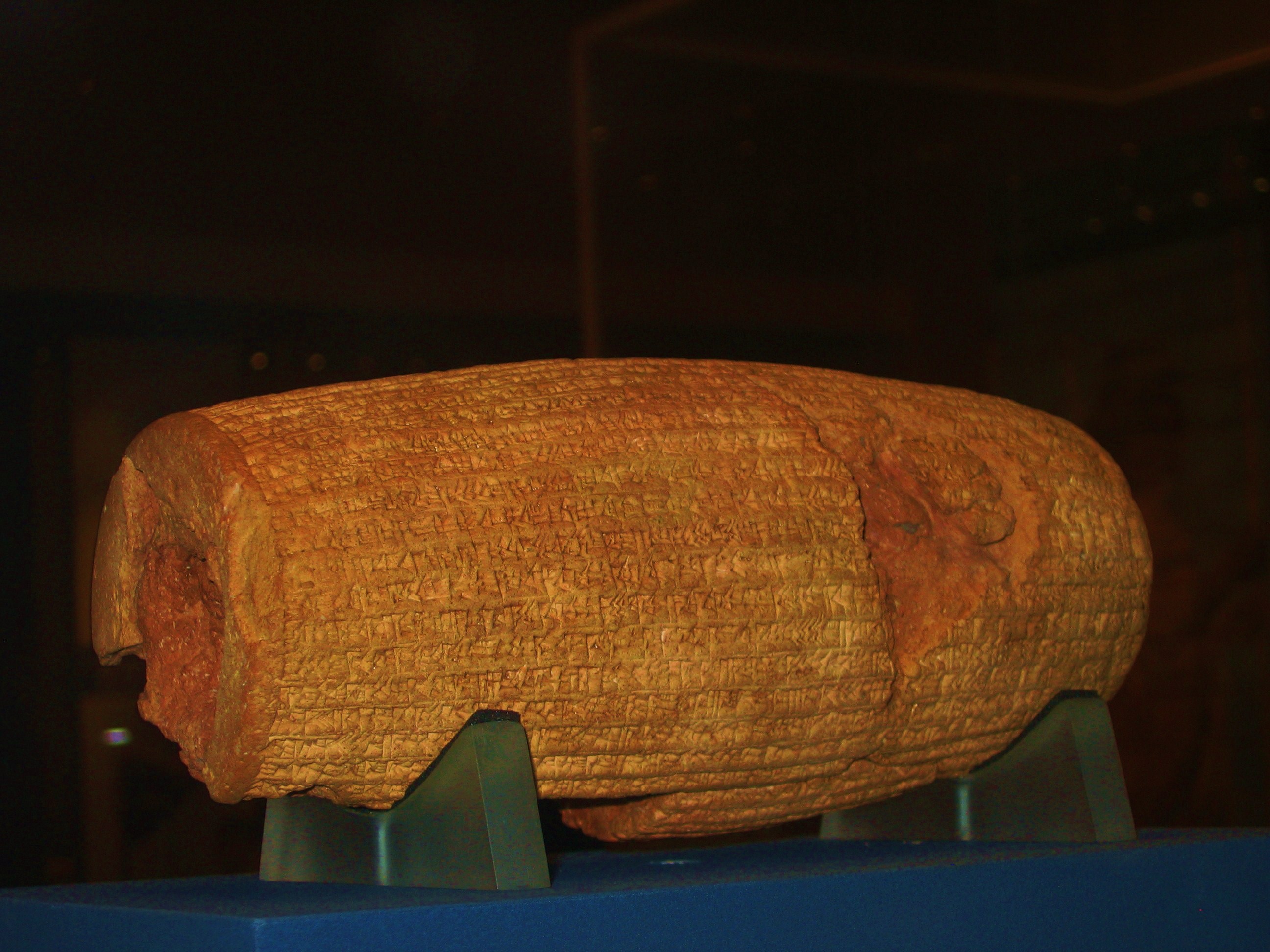
جـِبرِئیل

جـِبرِئیل، یکی از چهار فرشته مقرب و برترین آنها و در ادیان ابراهیمی، رابط میان خداوند و پیامبران بشمار می‌آید. این نام تلفظ‌های دیگری چون جبرائیل و جبریل نیز دارد. از جبرئیل به نام‌های فرشته وحی، امین وحی، عقل اول، ناموس اکبر، روح اعظم و ... نیز یاد می‌شود. حافظ او را سروش نامیده است.

در تاریخ یهودیت، مسیحیت و اسلام از نقش جبرئیل بسیار نقل شده‌است.

به باور پیروان این دین‌ها، جبرئیل ابراهیم را از آتش نجات داد، موسی را در مبارزه با فرعون حمایت کرد، فرعونیان را در رود نیل مصر غرق کرد، به داوود ساختن زره آموخت، به دانیال نبی تعبیر رؤیا آموخت، زکریا را به زاده شدن یحیی و مریم را به زایش عیسی مژده داد، و قرآن را بر محمد نازل کرد.

بنا به گفته پیروان اسلام او گاهی به صورت واقعی خود و گاهی به شکل جوانی خوشرو به نام دحیه کلبی نزد محمد می‌آمد. او در شب معراج همسفر محمد بود و در منتهای معراج، در سدرةالمنتهی باز ماند و به محمد گفت دیگر اجازه ندارد که پیش رود، و محمد به تنهایی به معراج ادامه داد.

بنا بر بعضی روایات مسلمانان، جبرائیل پنجاه بار بر ابراهیم، چهارصد بار بر موسی، ده بار بر عیسی و بیست و چهار هزار بار بر محمد نازل شده‌است.

شیخ مفید در روایتی آورده‌است: «جبرئیل در میان فرشتگان به شکل مردی میان بالا، سپید پیشانی، سیه چشم، و دارای چهار بال سبز مرصع لؤلؤ است.»

و در حدیث دیگری او دارای ششصد بال مرصع به دُر است.
ریشه‌شناسی

نام وی در زبان عبری (גַּבְרִיאֵל) به معنای «مرد خدا» است. همچنین در لاتین جبرئیل «گابریل» (Gabriel)نامیده می‌شود.

Gabriel
In Abrahamic religions, Gabriel (Bulgarian: Гавраил, Hebrew: גַּבְרִיאֵל, Modern Gavri'el Tiberian Gaḇrîʼēl - the strength of God; Latin: Gabrielus Serbian: Гаврило; Turkish: Cebrail; Greek: Γαβριήλ, Gabriēl; Arabic: جبريل, Jibrīl or جبرائيل Jibrail; Aramaic: Gabri-el, "God is my strong man/hero"[1]) is an archangel who serves as a messenger from God. He first appears in the Old Testament Book of Daniel, delivering explanations of Daniel's visions. Based on two passages in the Gospel of Luke, Gabriel foretold the births of both John the Baptist and Jesus. Christians of the catholic traditions refer to him as Saint Gabriel the Archangel.

Islamic views state that Jibrail was the medium through whom God revealed the Qur'an to Muhammad, and that he sent a message to most prophets, if not all, revealing their obligations. He is called the chief of the four favored angels and the spirit of truth. He is called, by Muslims, the created Holy Spirit (Islam) that spoke to Muhammad,[2][3] which is not to be confused with the Holy Spirit of God in Christianity who is revered as God Himself. Gabriel is also mentioned in Bahá'í Faith texts, specifically in Bahá'u'lláh's mystical work Seven Valleys.

According to the Biblical verses which specifically refer to him, Gabriel is likened to a mortal male, but is sometimes portrayed as androgynous or female, as in some New Age beliefs or contemporary art imagery.[4][5][6][7][8][9][10] In many nativity plays in schools, Gabriel is played by a female.
Christian references
Old Testament

In the book of Daniel, chapters 8:15-26 and 9:20-27, a being resembling a man and identified as Gabriel appears to the prophet Daniel to give him "skill and understanding" regarding his visions. In chapters 10:5-12:13, an unidentified being "dressed in linen" with the appearance of a man speaks with Daniel regarding future events. He tells Daniel that he had been sent to him but had been withstood by the "prince of the kingdom of Persia" for 21 days and that Michael (who is called a "chief prince") had to intervene in order for him to reach Daniel. This messenger is not specifically named but is interpreted contextually by some Christians to be Gabriel once again. The Arch angel Gabriel was captivated by one of the daughters of man, born within the time of Noah. The name of this female was Yaffa. Myth has it that from their union would be born the savior, Messiah.
New Testament

First, concerning John the Baptist, an angel appeared to his parents, as narrated in Luke 1:10–20 (MKJV):

"And all the multitude of the people were praying outside at the time of incense. (11) And an angel of the Lord appeared to him as he was standing on the right of the altar of incense. (12) And seeing this, Zacharias was troubled, and fear fell on him.

(13) But the angel said to him, Do not fear, Zacharias. For your prayer is heard, and your wife Elizabeth shall bear you a son, and you shall call his name John. (14) And you shall have joy and gladness, and many shall rejoice at his birth. (15) For he shall be great in the sight of the Lord, and shall neither drink wine nor strong drink. And he shall be filled with the Holy Spirit, even from his mother's womb. (16) And he shall turn many of the sons of Israel to the Lord their God. (17) And he shall go before him in the spirit and power of Elijah, to turn the hearts of the fathers to the children, and the disobedient to the wisdom of the just, to make ready a people prepared for the Lord.

(18) And Zacharias said to the angel, By what shall I know this? For I am old, and my wife is advanced in her days.

(19) And answering, the angel said to him, I am Gabriel, who stands before God. And I am sent to speak to you and to show you these glad tidings. (20) And behold, you shall be silent and not able to speak until the day that these things shall be performed, because you did not believe my words which shall be fulfilled in their time.[end]

Shortly afterwards, announcing the forthcoming birth of Jesus, Gabriel is said to appear again, this time to Elizabeth's close relative Mary; see Luke 1:26–37 (MKJV)

(26) And in the sixth month the angel Gabriel was sent from God into a city of Galilee, named Nazareth, (27) to a virgin betrothed to a man whose name was Joseph, of the house of David. And the virgin's name was Mary. (28) And the angel came in to her and said, Hail, full of grace, the Lord is with you. Blessed are you among women.

(29) And when she saw him, she was troubled at his saying, and considered what kind of greeting this might be. (30) And the angel said to her, Do not fear, Mary, for you have found favor with God. (31) And behold! You shall conceive in your womb and bear a son, and you shall call his name Jesus. (32) He shall be great and shall be called the Son of the Highest. And the Lord God shall give him the throne of his father David. (33) And he shall reign over the house of Jacob forever, and of his kingdom there shall be no end.

(34) Then Mary said to the angel, How shall this be, since I know not man?

(35) And the angel answered and said to her, The Holy Spirit shall come on you, and the power of the Highest shall overshadow you. Therefore also that Holy One which will be born of you shall be called Son of God. (36) And behold, your cousin Elizabeth also conceived a son in her old age. And this is the sixth month with her who was called barren. (37) For with God nothing shall be impossible.[end]

Gabriel only appears in these two passages in Luke and not in the other three Gospels.
Pseudepigraphy

According to the non-canonical Enoch 9:1–2, Gabriel, along with Michael, Raphael, Uriel and Suriel hear the cries of humanity under the strain of the Nephilim. It was their beseeching of "the Ancient of Days" (Yahweh), that prompted God to call Enoch to prophethood.

After Enoch informed the Watchers of their fall from grace, Yahweh sent the archangels to earth to complete various tasks. In Enoch 10:13, Gabriel was to "Go to the biters, to the reprobates, to the children of fornication, the offspring of the Watchers, from among men; bring them forth and excite them against one another. Let them perish under mutual slaughter; for length of days shall not be theirs." And so, Gabriel instigated wars among the Giants (the children of the Watchers).

Enoch 20:7 says that Gabriel presides over "Ikisat" (the fiery serpents) or Seraphim, Cherubim, and paradise, while Enoch 40:9 states that Gabriel presides over "all that is powerful." Gabriel sits on the left hand of God with Metatron.
Gabriel's Horn
In English-speaking culture, the image of Gabriel as the angel that shall blow the trumpet blast that initiates the end of time and the general resurrection at the Last Judgment, which has no source in the Hebrew Bible or the New Testament,[11] is a familiar trope; (This might be taken from Norse Heimdall who according to legends, will sound the Gjallarhorn, alerting the Æsir to the onset of Ragnarök where the world ends and is reborn.) it ranges from its first appearance in English in John Milton's Paradise Lost (1667)[12] to African-American spirituals: in Marc Connelly's play based on spirituals, The Green Pastures (1930), Gabriel has his beloved trumpet constantly with him, and the Lord has to warn him not to blow it too soon.[13] Four years later "Blow, Gabriel, Blow" was introduced by Ethel Merman in Cole Porter's Anything Goes (1934). The mathematical figure given the modern name "Gabriel's Horn", was invented by Evangelista Torricelli (1608–1647); it is a paradoxical solid of revolution that has infinite surface area, but finite volume.

In Islamic tradition, though not specified in the Qur'an, the trumpeter sounding the trump of doom[14] is not Gabriel, but Israfel.

The earliest identification of Gabriel as the trumpeter that S. Vernon McCasland was able to trace was in an Armenian illuminated manuscript dated 1455, at the Walters Art Museum, Baltimore.[15]
Feast days

The feast of Saint Gabriel was included for the first time in the General Roman Calendar in 1921, for celebration on March 24. In 1969 it was transferred to 29 September for celebration together with St. Michael and St. Raphael.[16] The Church of England has also adopted the 29 September date.

The Eastern Orthodox Church and those Eastern Catholic Churches which follow the Byzantine Rite celebrate his feast day on 8 November (for those churches that follow the traditional Julian Calendar, 8 November currently falls on 21 November of the modern Gregorian Calendar, a difference of 13 days). Eastern Orthodox commemorate him, not only on his November feast, but also on two other days: 26 March is the "Synaxis of the Archangel Gabriel" and celebrates his role in the Annunciation. 13 July is also known as the "Synaxis of the Archangel Gabriel", and celebrates all the appearances and miracles attributed to Gabriel throughout history. The feast was first established on Mount Athos when, in the ninth century, during the reign of Emperor Basil II and the Empress Constantina Porphyrogenitus, while Nicholas II Chrysoberges|Nicholas Chrysoverges was Patriarch of Constantinople, the Archangel appeared in a cell near Karyes, where he wrote with his finger on a stone tablet the hymn to the Theotokos, "It is truly meet..." (see Axion Estin).[17]

The Ethiopian Church celebrates his feast on 28 December, with a sizeable number of its believers making a pilgrimage to a church dedicated to "Saint Gabriel" in Kulubi on that day.[18]

Additionally Gabriel is the patron saint of messengers, those who work for broadcasting and telecommunications such as radio and television, remote sensing, and postal workers.
Latter-Day Saint view

In Latter-day Saint theology, Gabriel lived in this mortal life as the patriarch Noah. Gabriel and Noah are regarded as the same individual; Noah being his mortal name and Gabriel being his heavenly name.[19] See also: Noah, Michael (archangel), Adam.
Muslim references
The Arabic name for Gabriel is Jibral, Jibril, Jibrīl,Jibrael,Djibril, Jabrilæ or Jibrail (جبريل, جبرائيل, IPA: [dʒibræːʔiːl], [dʒibrɛ̈ʔiːl], or [dʒibriːl]) Muslims believe Gabriel to have been the angel who revealed the Qur'an to the prophet Muhammad.

Gabriel's physical appearance is described in the Hadith (Sahih al-Bukhari, 4:54:4:55):

    Na By Abu Ishaq-Ash-Shaibani: I asked Zir bin Hubaish regarding the Statement of God: "And was at a distance of but two bow-lengths or (even) nearer; So did (God) convey the inspiration to his servant (Gabriel) and then he (Gabriel) Conveyed (that to Muhammad). ([Qur'an 53:9]) From ‘Abdullaah ibn Mas‘ood, who said: the Messenger of God saw Gabriel in his true form. He had six hundred wings, each of which covered the horizon. There fell from his wings jewels, pearls and rubies, only God knows about them."[20]

Gabriel is regarded with the exact same respect by Muslims as all of the Prophets, and upon saying his name or referring to him a Muslim repeats: "peace be upon him". Gabriel's primary tasks are to bring messages from God to his messengers. As in Christianity, Gabriel is said to be the angel that informed Mary (Arabic Maryamمريم) of how she would conceive Jesus (Isa):

    She placed a screen (to screen herself) from them; then we sent to her our Ruh [angel Jibrael (Gabriel)], and he appeared before her in the form of a man in all respects. She said: "Verily! I seek refuge with the Most Beneficent (God) from you, if you do fear God." (The angel) said: "I am only a Messenger from your Lord, (to announce) to you the gift of a righteous son." She said: "How can I have a son, when no man has touched me, nor am I unchaste?" He said: "So (it will be), your Lord said: 'That is easy for me (God): And (we wish) to appoint him as a sign to mankind and a mercy from us (God), and it is a matter (already) decreed, (by God).' "
    (Quran, [Qur'an 19:17])

Muslims believe Gabriel to have accompanied Muhammad in his ascension to the heavens, where Muhammad also is said to have met previous messengers of God, and was informed about the Islamic prayer (Bukhari Sahih al-Bukhari, 1:8:345). Muslims also believe that Gabriel descends to Earth on the night of Laylat al-Qadr ("The Night of Destiny") not "the night of power" as some people think , its a night in the last ten days of the holy month of Ramadan in the Islamic calendar which is believed to be the night in which the Quran was first revealed.
Arts and media
Visual art
In chronological order (to see each item, follow the link in the footnote):[21]

    * Archangel Gabriel (Triptych), early 10th century, Benaki Museum
    * The Archangel Gabriel, Pisan, c. 1325/1350, National Gallery of Art
    * The Archangel Gabriel, Masolino da Panicale, c. 1420/30, National Gallery of Art
    * Justice between the Archangels Michael and Gabriel, Jacobello del Fiore, 1421
    * Merode Altarpiece (Triptych), Robert Campin, c. 1425, Metropolitan Museum of Art
    * The Angel Gabriel, Agostino di Duccio, c. 1450
    * Annunciation, Leonardo Da Vinci, c. 1475
    * The Angel Gabriel, Neroccio d'Landi, c. 1490
    * The Angel Gabriel, late 15th–early 16th century, Flemish, National Gallery of Art
    * The Angel Gabriel, Ferrari Gaudenzio, 1511, National Gallery, London
    * Gabriel delivering the AnnunciationEl Greco, 1575 (pictured above)
    * Go Down Death, Aaron Douglas, 1934

Music

    * The eccentric English hagiographer and antiquarian, Sabine Baring-Gould (1834–1924), wrote the English lyrics to Gabriel's Message, which he translated from the Basque Christmas carol Birjina gaztetto bat zegoen, which was probably related to the 13th or 14th century Latin chant Angelus Ad Virginem which itself is based on the Biblical account of the Annunciation in the New Testament Gospel of Luke.

Literature

    * In his epic poem Paradise Lost, John Milton made Gabriel chief of the angelic guards placed over Paradise.
    * The Hebrew poem "Elifelet" (אליפלט) by Nathan Alterman, put to music and often heard on the Israeli Radio, tells of a heroic, self-sacrificing Israeli soldier being killed in battle. Upon the protagonist's death, the angel Gabriel descends to Earth, in order to comfort the spirit of the fallen hero and take him up to Heaven.[22][23]
    * Salman Rushdie's Satanic Verses has his main character be the modern incarnation of Gabriel.

Radio, film and television

    * In the radio series Quiet, Please, episode #82 "Portrait Of A Character" (9 January 1949) is narrated by an individual known only as "Gabe", who enters a repair shop seeking to have his worn-out horn fixed. He mentions to the silent owner of the store that he requires the horn be repaired as soon as possible, because his "boss" is of the opinion that he (Gabe) will have a large event to play for soon. The story follows the lives of various immoral individuals and their sins being observed by Gabe as an unobserved third party waiting only for his "boss" to exact a suitable level of justice.[24]
    * In an episode of the original 1959 The Twilight Zone, entitled "A Passage for Trumpet", trumpet player Joey Crown (played by Jack Klugman) makes a decision to live or die with the help of a trumpet player who later turns out to be the angel Gabriel.
    * In The Prophecy trilogy of the 1990s, Gabriel (played by Christopher Walken) is portrayed as a villain and is jealous of humans for being God's favorites and wishes to destroy them all. In the second one, he is banished to be a human and it causes him to change his opinion of them. After helping Danyael out through the third movie, he is granted a second chance as an angel and ascends to Heaven once again.
    * In the 2004 film Van Helsing (film), Plays off Van Helsing's first name being Gabriel. It is stated he is the "God's Left Hand".
    * The 2005 film Constantine features an angelic character named Gabriel (played by Tilda Swinton), but this is not in fact the biblical archangel
    * The 2007 Australian film Gabriel tells the story of this Archangel who fights to bring light back to purgatory—a place where darkness rules—and save the souls of the city's inhabitants. Andy Whitfield portrays the title role.
    * The 2007 American film Salvation tells the story of the murder of the Knights Templar in 1307 by the Catholic Church for heresy. The souls of two of the Knights burned at the stake, Malchezidek and Gabriel (played by J.A. Steel) are condemned to continue the heavenly battle between good and evil, fighting for the souls of men.[25]
    * In the television series Supernatural season 5 episode, "Changing Channels" (2009), it is revealed that the recurring character the Trickster is actually the archangel Gabriel, played by the actor Richard Speight, Jr..
    * In the 2010 movie, Legion, Gabriel is played by Kevin Durand. He leads the armies of angels to enact God's will and exterminate humanity.

Other media

    * In the Shin Megami Tensei series of video games, Gabriel is portrayed as the only female Seraph and, in the second installment, stands apart from the other Seraphim when their goals diverge from God's.

Notes

   1. ^ Butler, Trent C. Editor, Holman Bible Dictionary, Broadman & Holman, 1991, entry Gabriel
   2. ^ Nader, M. The Holy Spirit in the Quran. Submission.org. Retrieved 11 August 2009.
   3. ^ Lil Abdo. "Female Representations of the Holy Spirit in Bahá'í and Christian writings and their implications for gender roles" Bahá'í Studies Review Volume 4.1, 1994. Retrieved 11 August 2009.
   4. ^ "Archangel Gabriel: Representation of a female or androgynous Gabriel". Angelgabriel.blogspot.com. 2007-09-19. http://angelgabriel.blogspot.com/2004/05/representation-of-female-or.html. Retrieved 2010-08-16.
   5. ^ "Wiki : Mythology". Otherkin.net. http://www.otherkin.net/wiki/Mythology/Angels. Retrieved 2010-08-16.
   6. ^ "Gabriel and The Year 2000: Tarot's Winter Angel". Newage-directory.com. http://www.newage-directory.com/gabriel.htm. Retrieved 2010-08-16.
   7. ^ www.anewbelief.com +44 1777 710999. "Archangel Gabriel". Anewbelief.com. http://www.anewbelief.com/Angels/gabriel.htm. Retrieved 2010-08-16.
   8. ^ "Archangel Gabriel - Folklore and Mythology". Bellaonline.com. http://www.bellaonline.com/articles/art26033.asp. Retrieved 2010-08-16.
   9. ^ "Archangel Gabriel (Saint Gabriel Archangel, Angel Gabriel), Messenger of God". Luckymojo.com. http://www.luckymojo.com/archangelgabriel.html. Retrieved 2010-08-16.
  10. ^ "Is the Angel Gabriel male or female? - Yahoo! UK & Ireland Answers". Uk.answers.yahoo.com. http://uk.answers.yahoo.com/question/index?qid=20080528125753AABHoaw. Retrieved 2010-08-16.
  11. ^ The angel is unnamed in Paul's description of the rising of the dead in 1 Thessalonians 4:13, which mentions the shout of an angel and the trumpet of God; nor is the angel named in other passages of the raising of the dead, such as Matthew 24:31 (angels' trumpet blast), John 5:25–29 (the voice of the Son of God); 1 Corinthians (a trumpet will sound); Revelation 8–11 (trumpets of seven angels).
  12. ^ Milton, Paradise Lost, XI.72ff was identified by S. Vernon McCasland, ("Gabriel's Trumpet" Journal of Bible and Religion 9.3 [August 1941:159–161] p. 161) as the first identification in English of Gabriel as the trumpeter: "Betwixt these rockie pillars Gabriel sat, Chief of the Angelic guards" (IV.545f)... he Blew his trumpet, heard in Oreb since perhaps When God descended, and perhaps once more To sound at general doom." (IX.73ff).
  13. ^ Both spirituals and Green Pastures were noted by McCasland 1941.
  14. ^ Trump of doom: "The wakeful trump of doom" is John Milton's phrase in his "Hymn on the morning of Christ's Nativity", drawing upon the King James Version's "We shall all be changed, in a moment, in the twinkling of an eye, at the last trump." (1 Corinthians 15:51f).
  15. ^ Walters MS 543, fol. 14.
  16. ^ Calendarium Romanum (Libreria Editrice Vaticana, 1969), p. 119)
  17. ^ Velimirovic, Bishop Nikolai (1985). "July 13: The Holy Archangel Gabriel". Prologue from Ochrid. Birmingham, UK: Lazarica Press. ISBN 978-0-948298-05-9. http://www.westsrbdio.org/prolog/my.html?month=July&day=13&Go.x=6&Go.y=12. Retrieved 2007-07-31.
  18. ^ Nega Mezlekia, Notes from the Hyena's Belly: An Ethiopian Childhood (New York: Picador, 2000), p. 266. ISBN 0-312-28914-6.
  19. ^ History of the Church of Jesus Christ of Latter-day Saints. Salt Lake City: Deseret News, 1902. v. 3 p. 386.
  20. ^ "Islam Question and Answer - Al-Malaa’ikah (Angels)". Islamqa.com. http://islamqa.com/en/ref/843/gabriel%20wings. Retrieved 2010-08-16.
  21. ^ "Links to images of Gabriel". The Text This Week. http://www.textweek.com/art/gabriel.htm. Retrieved 2007-02-12.
  22. ^ "התרנגולים - אליפלט - שירונט". Shiron.net. http://www.shiron.net/songView.aspx?song_id=307&singer_id=352&song_title=6cd6. Retrieved 2010-08-16.
  23. ^ "אין לו אופי אפילו במיל". Haayal.co.il. http://www.haayal.co.il/story_1720. Retrieved 2010-08-16.
  24. ^ Lannan, Kelly Patrick. (1977 ~ current) Base Koala TX Data Archives
  25. ^ "The Salt Lake Tribune" (USA) 8 January 2008, pg. E1-E2, by Brandon Griggs, "Woman of Steel"


References
    * Bamberger, Bernard Jacob, (15 March 2006). Fallen Angels: Soldiers of Satan's Realm. Jewish Publication Society of America. ISBN 0-8276-0797-0
    * Briggs, Constance Victoria, 1997. The Encyclopedia of Angels: An A-to-Z Guide with Nearly 4,000 Entries. Plume. ISBN 0-452-27921-6.
    * Bunson, Matthew, (1996). Angels A to Z: A Who's Who of the Heavenly Host. Three Rivers Press. ISBN 0-517-88537-9.
    * Cruz, Joan C. 1999. Angels and Devils. Tan Books & Publishers. ISBN 0-89555-638-3.
    * Davidson, Gustav. A Dictionary of Angels: Including the Fallen Angels. Free Press. ISBN 0-02-907052-X
    * Graham, Billy, 1994. Angels: God's Secret Agents. W Pub Group; Minibook edition. ISBN 0-8499-5074-0
    * Guiley, Rosemary, 1996. Encyclopedia of Angels. ISBN 0-8160-2988-1
    * Kreeft, Peter J. 1995. Angels and Demons: What Do We Really Know About Them? Ignatius Press. ISBN 0-89870-550-9
    * Lewis, James R. (1995). Angels A to Z. Visible Ink Press. ISBN 0-7876-0652-9
    * Melville, Francis, 2001. The Book of Angels: Turn to Your Angels for Guidance, Comfort, and Inspiration. Barron's Educational Series; 1st edition. ISBN 0-7641-5403-6
    * Ronner, John, 1993. Know Your Angels: The Angel Almanac With Biographies of 100 Prominent Angels in Legend & Folklore-And Much More! Mamre Press. ISBN 0-932945-40-6.

منابع


    * دایرةالمعارف تشیع، ج ۵؛
    * الاختصاص، ص ۴۵؛
    * بحارالانوار، ج ۲۵؛
    * دانشنامه قرآن و قرآن پژوهی، ج ۱